Friday, March 29, 2019
Free Breast Forms
A simple order form you can share around, for anyone who wants free crochet breast forms (for bra stuffing) - anonymous orders allowed! https://docs.google.com/forms/d/e/1FAIpQLSeWNses5JmjK_D88uKF58t0qyvwXDTAq63whOU1BUOGppr19w/viewform

Saturday, September 29, 2018
The Upside-Down Narrative of "Power Under Abuse"
This is one of the worst The Discourse 👌 I've ever seen. The list of "abusive toward people with power over you" traits are basically identical to a list of behaviors commonly displayed by victims of CPTSD.
Yes, it can be difficult for CPTSD victims to realize that the same habits they relied upon to survive ongoing trauma are the very sorts of habits that will destroy healthy relationships. Yes, CPTSD victims can still be (for example) racist and transphobic, despite otherwise not holding power over. But that doesn't translate to "this person I hold power over is gaslighting and abusing me".
If you find yourself struggling to cope with the emotional turmoil that can often come with relationships with CPTSD victims you hold power over, maybe exercise that power you hold to take a break to take care of yourself. Then revisit the issue at a time you both agree on; you setting this boundary might trigger their abandonment issues, but state firmly and compassionately that you want to be able to be emotionally centered and present to provide them the best support you are able, and that requires self-care first. Remember that no matter how much this might feel like gaslighting, this person is struggling with dark thoughts that make it all feel so very real to them, and that you turning the tables on them to paint them as "the real abuser" will only perpetuate the emotional nightmare they wish they could escape.
Lastly, take a good hard look at yourself. Are you in denial about leveraging the power you hold over this person? Are you possibly over-extending yourself and your capacity to provide competent emotional care for another person? You might actually need to get help to figure out the answers to these questions.
– telling someone that their basic needs or boundaries are not valid because of their privilege or power.https://thebodyisnotanapology.com/magazine/what-do-we-do-when-someone-with-less-social-privilege-is-abusive-to-someone-with-more-social-privilege-poplar-rose/
– using shame inducing social justice language to pressure people to do things they don’t want to do.
– pressuring someone to have sex they don’t want to have, by telling them they are harming you if they say no. ie. “if you don’t have sex with me, you are ___phobic.”
– accusing someone of harming you because they are requesting conflict resolution with you.
– accusing someone of harming you in ways that did not actually happen, or exaggerating harm that did happen. sometimes these accusations are made public through call-outs.
– calling for ostracization or punishment that is not proportionate to the harm done.
– refusing to absorb feedback offered by friends and loved ones who witness you causing harm.
– refusing to accept support from anyone other than the person you are being abusive towards.
– refusing to acknowledge care given to you by the person you are in conflict with and instead characterizing them as only ever having had harmed you.
– leveraging shame or guilt to pressure someone not to set boundaries.
– accusing someone of abandoning you when they set boundaries.
– refusing to set your own boundaries and then making statements like “you made me do this”.
– constantly accusing other people of being oppressive, harmful, abusive, toxic etc, while simultaneously being unwilling to unpack the way you embody these things.
– not acknowledging the struggle, victimization or oppression experienced by the person you are abusing.
– convincing the person you are abusing that they have more power (in general and specifically over you) than they actually do.
– refusing to address conflict in a way that honours the integrity and humanity of everyone involved. ie: not using someone’s current gender pronoun when you call them out.
– stealing from the person you are being abusive towards and either denying you stole, or claiming you have a right to the thing you stole because you have less than the person you stole from (which may or may not actually be true).
– accusing someone of triangulating or breaking confidentiality when they seek support to navigate the abusive dynamic they are in with you
– claiming to be ‘getting support’ and ‘calling in witnesses’ when you are spreading rumours for your benefit.
– weaponizing pop psychology terms like “toxic”, “narcissist” and “empath”, often with little understand of what these words were originally meant to describe. Ie: narcissism is a mental illness which requires diagnosis based on a set of criteria. it’s not meant to be used to describe someone who thinks about themselves more than you would like them to think about you.
– labelling confusion, miscommunication or difference of opinion as gaslighting.
Yes, it can be difficult for CPTSD victims to realize that the same habits they relied upon to survive ongoing trauma are the very sorts of habits that will destroy healthy relationships. Yes, CPTSD victims can still be (for example) racist and transphobic, despite otherwise not holding power over. But that doesn't translate to "this person I hold power over is gaslighting and abusing me".
If you find yourself struggling to cope with the emotional turmoil that can often come with relationships with CPTSD victims you hold power over, maybe exercise that power you hold to take a break to take care of yourself. Then revisit the issue at a time you both agree on; you setting this boundary might trigger their abandonment issues, but state firmly and compassionately that you want to be able to be emotionally centered and present to provide them the best support you are able, and that requires self-care first. Remember that no matter how much this might feel like gaslighting, this person is struggling with dark thoughts that make it all feel so very real to them, and that you turning the tables on them to paint them as "the real abuser" will only perpetuate the emotional nightmare they wish they could escape.
Lastly, take a good hard look at yourself. Are you in denial about leveraging the power you hold over this person? Are you possibly over-extending yourself and your capacity to provide competent emotional care for another person? You might actually need to get help to figure out the answers to these questions.
Thursday, August 30, 2018
Leveraging Intersex
I’ve been bad about this, and continually need to check myself, but leveraging the existence of intersex people in gender discourse is frequently objectification and erasure both. I don’t need to explain or justify my genitals to anyone - nobody does. And people do know about intersex bodies - they’re fully aware and have enacted great violence upon those individuals to “normalize” them. It’s not that some people don’t think a wide spectrum of humanity exists, it’s that some people think we shouldn’t exist even when we do.
Saturday, April 28, 2018
Realness
Every time I try to write about my family, I feel at a loss for words. I see friends sharing so many beautiful thoughts and photos of their families, and I love it. I love seeing the vibrant energy that comes from getting to share life with each other, and I'm glad that you're sharing your happiness and your sorrows with me.
I think of how I would share my own, and I'm overwhelmed with so many feelings and memories to choose from. How do I describe that which takes no words to experience? There is no analysis to dissect the soft touch of lips on neck, of nose pressed to nose, no photoset of the hopeful fearful dreaming of the future.
How do I possibly approach the looming spectre of misrepresentation? When the only positive example of nonmonogamy I know to point to is drawn from the mind of a dirty computer one short day ago, how do I possibly avoid the stereotype threat pressing my own free expression back into hiding?
I live my life as a fake person only seen for how closely I can imitate realness. I know that every story, every image, will be scrutinized for which relationship is the real one. Which person is the person I love the most? Which would I sacrifice everything for? Which part of my life should I stop pretending?
And then I think about the richness and fullness of our lives, and how many people I know are struggling for even a fraction of that, and I worry that I would ever cause another person pain of longing or envy.
So I leave things unsaid. The deep abiding commitment, the joy of flourishing affection, the fear that at any moment it could all be taken away. Maybe one day we all will get to be possible.
I think of how I would share my own, and I'm overwhelmed with so many feelings and memories to choose from. How do I describe that which takes no words to experience? There is no analysis to dissect the soft touch of lips on neck, of nose pressed to nose, no photoset of the hopeful fearful dreaming of the future.
How do I possibly approach the looming spectre of misrepresentation? When the only positive example of nonmonogamy I know to point to is drawn from the mind of a dirty computer one short day ago, how do I possibly avoid the stereotype threat pressing my own free expression back into hiding?
I live my life as a fake person only seen for how closely I can imitate realness. I know that every story, every image, will be scrutinized for which relationship is the real one. Which person is the person I love the most? Which would I sacrifice everything for? Which part of my life should I stop pretending?
And then I think about the richness and fullness of our lives, and how many people I know are struggling for even a fraction of that, and I worry that I would ever cause another person pain of longing or envy.
So I leave things unsaid. The deep abiding commitment, the joy of flourishing affection, the fear that at any moment it could all be taken away. Maybe one day we all will get to be possible.
Thursday, September 28, 2017
Sexual Cinnamon Rolls
Growing up in a conservative Christian community, STIs were portrayed as something that happens to people who stray from the right path: total and complete monogamy with 1 single person for life. Condoms are completely unnecessary to learn about under that model; in fact, buying condoms means you're planning to sin, so don't. When I left Christianity and monogamy behind, and joined polyamorous spaces, it would have been a good opportunity to be deprogrammed of this toxic mindset toward condoms.
However, that's not what happened. Instead of condoms and dental dams being stigmatized for their accessory to a sinful lifestyle, they were now stigmatized for their accessory to a relationship lacking in trust and intimacy. Instead of STIs being the wages of sin, they were now a sign of a dirty person. It's really difficult to unfuck one's own mind under those conditions!
Everywhere I turned, the pinnacle of polyamory was "getting" to have sex without a condom with "fluid-bonded" partners. A thin sheet of latex became the barrier surrounding a gated community, separating those deserving of intimacy from those merely allowed the scraps of the bountiful love of the privileged. Relationship rules were written up like homeowners association covenants, ensuring that any interactions with outsiders would be highly regulated in a way that would remind the newcomer of their inherent dirtiness and undeservingness of love and affection, as certain sex acts were elevated higher than others, only to be claimed as if by birthright by those with purest blood.
One of the major factors fueling the recent uprise in STIs is that people won't get tested or treated - the stigma is too great. Well, no wonder, when having one is treated like the Mark of Cain! When you stand to lose access to entire communities of support from even admitting you're capable of catching an infectious disease, where's your incentive for confronting something that frequently won't show any symptoms at all? (I know not everyone can afford medical care; however this is another way that communities could come together, and offer to cover the bill.)
Why is it so hard for us to stop using each other's bodies as tools for our own validation? Why do we insist that partners put our feelings before their own health? #abuseculture Fluid barriers need to become a primary way to show we care about each other's health. You're not a sexual cinnamon roll: too good for this condom, too pure. We need to stop treating people with STIs as less deserving of intimacy, rather than as being in need of accommodations and support.
However, that's not what happened. Instead of condoms and dental dams being stigmatized for their accessory to a sinful lifestyle, they were now stigmatized for their accessory to a relationship lacking in trust and intimacy. Instead of STIs being the wages of sin, they were now a sign of a dirty person. It's really difficult to unfuck one's own mind under those conditions!
Everywhere I turned, the pinnacle of polyamory was "getting" to have sex without a condom with "fluid-bonded" partners. A thin sheet of latex became the barrier surrounding a gated community, separating those deserving of intimacy from those merely allowed the scraps of the bountiful love of the privileged. Relationship rules were written up like homeowners association covenants, ensuring that any interactions with outsiders would be highly regulated in a way that would remind the newcomer of their inherent dirtiness and undeservingness of love and affection, as certain sex acts were elevated higher than others, only to be claimed as if by birthright by those with purest blood.
One of the major factors fueling the recent uprise in STIs is that people won't get tested or treated - the stigma is too great. Well, no wonder, when having one is treated like the Mark of Cain! When you stand to lose access to entire communities of support from even admitting you're capable of catching an infectious disease, where's your incentive for confronting something that frequently won't show any symptoms at all? (I know not everyone can afford medical care; however this is another way that communities could come together, and offer to cover the bill.)
Why is it so hard for us to stop using each other's bodies as tools for our own validation? Why do we insist that partners put our feelings before their own health? #abuseculture Fluid barriers need to become a primary way to show we care about each other's health. You're not a sexual cinnamon roll: too good for this condom, too pure. We need to stop treating people with STIs as less deserving of intimacy, rather than as being in need of accommodations and support.
Saturday, April 22, 2017
It's not just about the restrooms but because you all keep making it about the restrooms we can talk about that...
Presented to Celebrate Diversity 2017 in Warsaw, Indiana.
I stand with my young child and face two doors, knowing what I need can be found behind both, aware that choosing one over the other is to publicly declare my deepest political allegiances. I casually make my way through Door #1, hoping nobody will notice. “Sir” I look up, and realize she’s looking directly at me. I’ve been found out. “Sir, you want to be over there,” she commands as she points directly toward Door #2, valiantly defending the innocence of the flock of preschool girls we’re both surrounded by. We go into the other room without a fuss. My child peers into a nearby urinal with suspicion at its contents, then up at me. “Mommy, what-” I swiftly brush him into the nearest stall before he can utter any more incriminating words, not knowing how to explain to a preschooler that there is no Door #3 for people like me.
There is a chance that any time you or your loved ones enters a public restroom, that they could be sharing it with a sex offender. Child molesters, voyeurs/exhibitionists, date rapists - these are all people who buy the same groceries as us, eat at the same restaurants as us, and fill up at the same gas stations as us. If you were the type to be concerned about safety in public restrooms, and believed that legislation were an effective tool to protect restroom patrons, what could you do about this situation? If your proposed response is to outlaw transgender people, you just might be Indiana Republican state Senator Jim Tomes. Bear with me, I’m quoting him verbatim: “What about the other sector of society of people that who have all through the decades women been using women’s restrooms and men been using men’s restrooms and kind of like that and kind of expect that level of privacy?”
Don’t worry about people who are actually predators and convicted sex offenders; the real danger has been me all along! Nevermind that if there really were an epidemic of cross-dressing voyeurs peeping under bathroom stalls, Fox News would be plastering their mug shots all over scare pieces in a never-ending parade of shame. Meanwhile, the true stories of abuse and violence against transgender folks in public spaces get pushed to the back pages of the news.
I don't like the men's restrooms because I'm not a man, I’m nonbinary. I am familiar with the women's restrooms, but I'm not a woman, and I raise far too many suspicions in there now for my comfort anyway. I have gotten very skilled at finding single-user restrooms wherever I go, but I will use the men's room now if it's urgent, and carry myself with the confidence of a mediocre white man in a generally successful attempt to blend in.
I’m disturbed by a trend lately, where some men gleefully plot for (or at least dream about) pushing themselves into women's restrooms in an attempt to get kicked out. Sometimes it’s cis men [“cisgender” means someone who is not transgender]. These cis men are attempting to “prove” that anyone can “fake” being trans simply by throwing on a dress. Sometimes it’s trans men posting selfies, and then "surprise! I have a vagina!" It's supposed to “prove” that they don't belong in women’s restrooms because they "look like a man". The problem is that all of this harms women. Many trans women are suspected of “faking” their genders and that's why these laws are being passed in the first place. They are enforced by targeting women who “look like men”, which hurts all women, trans and cis alike. Plus, at its most basic this trend an example of cis and trans men forcing their way past women’s stated boundaries in an attempt to intimidate them to get their own way. What if masculinity were used for justice instead of violence?
In many states, there has never been a law explicitly against using the "wrong" restroom. So why after over 100 years of trans people in multi-user public restrooms - yes, we've always been using them, even if you didn't notice - why now do we suddenly have this deep and urgent need for laws to segregate and outlaw us? Honestly, it's for the money. This is a great way to scare people into donating money to the political campaign or advocacy organization of their choice. I'm including pro-LGBT orgs here: many of them use fear tactics to profit from our situation too.
Even if laws were passed explicitly to protect people like me, we still wouldn't be safe. Laws can only provide recourse against harms already caused, for those of us who can even afford legal action, but they don’t change the hearts and minds of those who act against us. The fact is, we cannot be safe in a society that demands segregation. I mean that in the fullest sense. We cannot be safe in a society that demands “separate yet equal” restrooms.
Racial segregation dates back to 1849; the first separate gendered restroom ordinances came 40 years later, in 1887. When you dig into the arguments presented when proposing these gendered restrictions over the past century, you will find that it wasn’t about protecting women from men, it especially wasn’t about protecting black women from white men, it was always about protecting white women from black men by demonizing blackness. Segregated restrooms have always been racist as well as sexist, and as such will always be unsafe.
I again want to make it very clear that the root of the violence against my people isn’t the laws, it’s the prevailing mentality of a society that accepts a certain order of things as “normal”, and anyone who deviates is deemed in need of correction. In a society where all genders were valid and deserving of equal recognition and protection, it would be unthinkable to demand some of us to hide ourselves while others flaunt your “normal” genders every chance you get. You accept gender segregation because you don’t see us as real people.
For example: a friend of mine on Facebook recently posted that she defended the right of trans women to use the women’s restroom alongside herself, but she wanted to ask all trans women to please place the seat down after they were finished. Several of her friends chimed in their complaints in the comments. I think they thought they were being cute, but the message was clear: normal women keep the seat down, fake women leave it up. It never occurred to them that if a trans woman leaves the seat up, then leaving the seat up is a normal way for women to use the toilet, because trans women are women, not objects for your scrutiny.
Separating us out as not normal, not like you, not fully people leaves us vulnerable even in places that aren’t segregated by gender, even in places designated specifically for us. Stonewall Inn, site of the Stonewall Riots of 1969, is famed as the birthplace of the modern gay rights movement. In March of last year, a transgender woman went into the single-user restroom of Stonewall Inn, and video surveillance shows a man following her in there, where he then attacked and raped her. There are no safe spaces for people who are deemed less than human.
Two years ago, I spent the weekend traveling the beautiful Ozarks of Missouri with my child and my transgender wife. We stopped at a gas station to fill up, and we needed a bathroom break. It was a tiny place with a single-user restroom on the exterior of the building, so we sat on the nearby bench to wait our turn. The man standing next in line before us refused to budge. Soon he was joined by another man, forming a barricade. A woman came out and begged him not to start anything, to just let us go. We quickly realized they were targeting us, refusing to let us access the single-user restroom, willing to escalate to violence if necessary. They didn’t see a family with a child. They didn’t see people. They just saw some deviants with fake genders. We will never be safe until we are real.
I stand with my young child and face two doors, knowing what I need can be found behind both, aware that choosing one over the other is to publicly declare my deepest political allegiances. I casually make my way through Door #1, hoping nobody will notice. “Sir” I look up, and realize she’s looking directly at me. I’ve been found out. “Sir, you want to be over there,” she commands as she points directly toward Door #2, valiantly defending the innocence of the flock of preschool girls we’re both surrounded by. We go into the other room without a fuss. My child peers into a nearby urinal with suspicion at its contents, then up at me. “Mommy, what-” I swiftly brush him into the nearest stall before he can utter any more incriminating words, not knowing how to explain to a preschooler that there is no Door #3 for people like me.
There is a chance that any time you or your loved ones enters a public restroom, that they could be sharing it with a sex offender. Child molesters, voyeurs/exhibitionists, date rapists - these are all people who buy the same groceries as us, eat at the same restaurants as us, and fill up at the same gas stations as us. If you were the type to be concerned about safety in public restrooms, and believed that legislation were an effective tool to protect restroom patrons, what could you do about this situation? If your proposed response is to outlaw transgender people, you just might be Indiana Republican state Senator Jim Tomes. Bear with me, I’m quoting him verbatim: “What about the other sector of society of people that who have all through the decades women been using women’s restrooms and men been using men’s restrooms and kind of like that and kind of expect that level of privacy?”
Don’t worry about people who are actually predators and convicted sex offenders; the real danger has been me all along! Nevermind that if there really were an epidemic of cross-dressing voyeurs peeping under bathroom stalls, Fox News would be plastering their mug shots all over scare pieces in a never-ending parade of shame. Meanwhile, the true stories of abuse and violence against transgender folks in public spaces get pushed to the back pages of the news.
I don't like the men's restrooms because I'm not a man, I’m nonbinary. I am familiar with the women's restrooms, but I'm not a woman, and I raise far too many suspicions in there now for my comfort anyway. I have gotten very skilled at finding single-user restrooms wherever I go, but I will use the men's room now if it's urgent, and carry myself with the confidence of a mediocre white man in a generally successful attempt to blend in.
I’m disturbed by a trend lately, where some men gleefully plot for (or at least dream about) pushing themselves into women's restrooms in an attempt to get kicked out. Sometimes it’s cis men [“cisgender” means someone who is not transgender]. These cis men are attempting to “prove” that anyone can “fake” being trans simply by throwing on a dress. Sometimes it’s trans men posting selfies, and then "surprise! I have a vagina!" It's supposed to “prove” that they don't belong in women’s restrooms because they "look like a man". The problem is that all of this harms women. Many trans women are suspected of “faking” their genders and that's why these laws are being passed in the first place. They are enforced by targeting women who “look like men”, which hurts all women, trans and cis alike. Plus, at its most basic this trend an example of cis and trans men forcing their way past women’s stated boundaries in an attempt to intimidate them to get their own way. What if masculinity were used for justice instead of violence?
In many states, there has never been a law explicitly against using the "wrong" restroom. So why after over 100 years of trans people in multi-user public restrooms - yes, we've always been using them, even if you didn't notice - why now do we suddenly have this deep and urgent need for laws to segregate and outlaw us? Honestly, it's for the money. This is a great way to scare people into donating money to the political campaign or advocacy organization of their choice. I'm including pro-LGBT orgs here: many of them use fear tactics to profit from our situation too.
Even if laws were passed explicitly to protect people like me, we still wouldn't be safe. Laws can only provide recourse against harms already caused, for those of us who can even afford legal action, but they don’t change the hearts and minds of those who act against us. The fact is, we cannot be safe in a society that demands segregation. I mean that in the fullest sense. We cannot be safe in a society that demands “separate yet equal” restrooms.
Racial segregation dates back to 1849; the first separate gendered restroom ordinances came 40 years later, in 1887. When you dig into the arguments presented when proposing these gendered restrictions over the past century, you will find that it wasn’t about protecting women from men, it especially wasn’t about protecting black women from white men, it was always about protecting white women from black men by demonizing blackness. Segregated restrooms have always been racist as well as sexist, and as such will always be unsafe.
I again want to make it very clear that the root of the violence against my people isn’t the laws, it’s the prevailing mentality of a society that accepts a certain order of things as “normal”, and anyone who deviates is deemed in need of correction. In a society where all genders were valid and deserving of equal recognition and protection, it would be unthinkable to demand some of us to hide ourselves while others flaunt your “normal” genders every chance you get. You accept gender segregation because you don’t see us as real people.
For example: a friend of mine on Facebook recently posted that she defended the right of trans women to use the women’s restroom alongside herself, but she wanted to ask all trans women to please place the seat down after they were finished. Several of her friends chimed in their complaints in the comments. I think they thought they were being cute, but the message was clear: normal women keep the seat down, fake women leave it up. It never occurred to them that if a trans woman leaves the seat up, then leaving the seat up is a normal way for women to use the toilet, because trans women are women, not objects for your scrutiny.
Separating us out as not normal, not like you, not fully people leaves us vulnerable even in places that aren’t segregated by gender, even in places designated specifically for us. Stonewall Inn, site of the Stonewall Riots of 1969, is famed as the birthplace of the modern gay rights movement. In March of last year, a transgender woman went into the single-user restroom of Stonewall Inn, and video surveillance shows a man following her in there, where he then attacked and raped her. There are no safe spaces for people who are deemed less than human.
Two years ago, I spent the weekend traveling the beautiful Ozarks of Missouri with my child and my transgender wife. We stopped at a gas station to fill up, and we needed a bathroom break. It was a tiny place with a single-user restroom on the exterior of the building, so we sat on the nearby bench to wait our turn. The man standing next in line before us refused to budge. Soon he was joined by another man, forming a barricade. A woman came out and begged him not to start anything, to just let us go. We quickly realized they were targeting us, refusing to let us access the single-user restroom, willing to escalate to violence if necessary. They didn’t see a family with a child. They didn’t see people. They just saw some deviants with fake genders. We will never be safe until we are real.
Tuesday, April 4, 2017
Do I Look Like I Belong in Here?
Content note: bathroom bills, transmisogyny, violation of boundaries (any others?)
I don't like the men's restrooms because I'm not a man, I’m nonbinary. I am familiar with the women's restrooms, but I'm not a woman, and I raise far too many suspicions in there now for my comfort anyway. I have gotten very skilled at finding single-user restrooms wherever I go, but I use the men's room now if it's urgent and carry myself with the confidence of a mediocre white man in a generally successful attempt to blend in.
I’m disturbed by a trend lately, where men gleefully plot for (or at least dream about) pushing themselves into women's restrooms to get kicked out, sometimes posting selfies, and then "surprise! I have a vagina because I'm trans!" It's supposed to "disprove" oppressive bathroom bills, by showing that they don't belong in women’s restrooms because they "look like a man".
The problem is that this harms women. Many trans women are suspected of "looking like a man" and that's why these laws are being passed in the first place. Plus, at its most basic this is an example of men forcing their way past [trans and cis] women’s stated boundaries. What if masculinity were used for justice instead of violence?
To the white boys out there interrupting the conversation with your “but what about?”: There's a key difference between "using the women's restroom to get noticed" and "using the women's restroom to avoid being noticed". I understand as well as any trans person that as long as restrooms are segregated, none of us are really safe. But please join me in working against transmisogyny in our words and actions.
I don't like the men's restrooms because I'm not a man, I’m nonbinary. I am familiar with the women's restrooms, but I'm not a woman, and I raise far too many suspicions in there now for my comfort anyway. I have gotten very skilled at finding single-user restrooms wherever I go, but I use the men's room now if it's urgent and carry myself with the confidence of a mediocre white man in a generally successful attempt to blend in.
I’m disturbed by a trend lately, where men gleefully plot for (or at least dream about) pushing themselves into women's restrooms to get kicked out, sometimes posting selfies, and then "surprise! I have a vagina because I'm trans!" It's supposed to "disprove" oppressive bathroom bills, by showing that they don't belong in women’s restrooms because they "look like a man".
The problem is that this harms women. Many trans women are suspected of "looking like a man" and that's why these laws are being passed in the first place. Plus, at its most basic this is an example of men forcing their way past [trans and cis] women’s stated boundaries. What if masculinity were used for justice instead of violence?
To the white boys out there interrupting the conversation with your “but what about?”: There's a key difference between "using the women's restroom to get noticed" and "using the women's restroom to avoid being noticed". I understand as well as any trans person that as long as restrooms are segregated, none of us are really safe. But please join me in working against transmisogyny in our words and actions.
Sunday, November 20, 2016
Suffering as Social Capital
I see a dangerous idea circulating: the idea of suffering as social capital.
I see it in the way many will regard suffering to be the determining factor for transness: more suffering/dysphoria = more trans; the most true form of transness being death itself. (Glares at truscum.)
I see it in activist circles too, the idea that the more you suffer for The Cause, the more radical you are. Isn't the perk of socialism that it does not demand equal labor from all people? We seek liberation. Why would we replicate the destructive approach to get there that capitalism offers? Why would we demand those with different abilities to perform the same productivity or else deem they be accorded less liberation?
Sometimes it feels like everything is violence and hate and it becomes overwhelming. Then a friend talks about how they made pudding, and I can be a little more okay. I need that connection with others. I need solidarity. People on Facebook are what keeps me going, are part of what fuels the revolution. If there's no room for people who can post things on Facebook and make pudding, stop the bus and let me off, I will take no part of this fake socialism.
I see it in the way many will regard suffering to be the determining factor for transness: more suffering/dysphoria = more trans; the most true form of transness being death itself. (Glares at truscum.)
I see it in activist circles too, the idea that the more you suffer for The Cause, the more radical you are. Isn't the perk of socialism that it does not demand equal labor from all people? We seek liberation. Why would we replicate the destructive approach to get there that capitalism offers? Why would we demand those with different abilities to perform the same productivity or else deem they be accorded less liberation?
Sometimes it feels like everything is violence and hate and it becomes overwhelming. Then a friend talks about how they made pudding, and I can be a little more okay. I need that connection with others. I need solidarity. People on Facebook are what keeps me going, are part of what fuels the revolution. If there's no room for people who can post things on Facebook and make pudding, stop the bus and let me off, I will take no part of this fake socialism.
Monday, August 8, 2016
The Violence of Personal Preferences
I see a disturbing pattern in conversations from time to time.
Person targeted with violence and oppression: "This thing hurts me."
Person who isn't targeted the same way: "But it's my personal preference."
It is not only possible, but it is highly probable that your personal preferences were shaped by the same culture of violence that the targeted person wants to be free from.
It is not your fault that your personal preferences are ones which perpetuate violence; however it is your responsibility to reshape your own thoughts and actions to minimize your contribution to violence, and it is your fault if you make excuses instead of doing the hard work.
At no point do you need to explain your violent preferences to the targets of oppression. At no point do you need us to make you feel better for having them.
Person targeted with violence and oppression: "This thing hurts me."
Person who isn't targeted the same way: "But it's my personal preference."
It is not only possible, but it is highly probable that your personal preferences were shaped by the same culture of violence that the targeted person wants to be free from.
It is not your fault that your personal preferences are ones which perpetuate violence; however it is your responsibility to reshape your own thoughts and actions to minimize your contribution to violence, and it is your fault if you make excuses instead of doing the hard work.
At no point do you need to explain your violent preferences to the targets of oppression. At no point do you need us to make you feel better for having them.
Wednesday, May 11, 2016
"Natural"
"Natural" is meaningless. "Natural" is artifice. "Natural" is the greatest sham of the century.
I fucking hate when people act like the mind is not part of the body, nor the body part of society. Meaningless distinctions.
My gender is all in your head.
It's something I realized back when I finally stopped pretending to be female. It really is all up to the beholder what they think gender is in general, and what my gender is by extension. I don't mean they determine for me what my gender is; their gender of me has tangible consequences for me. I can be completely honest in my comportment, and that does have some influence, but ultimately I'm not the author of my gender in their minds. Each time I am observed, they are creating a new gender, a spectre in their minds which is real as every other thought or experience they have.
It's important to note that this is identical to the gendering conflated onto cis people. The only difference is some gender spectres have a revocable aura of "natural".
👌
I fucking hate when people act like the mind is not part of the body, nor the body part of society. Meaningless distinctions.
My gender is all in your head.
It's something I realized back when I finally stopped pretending to be female. It really is all up to the beholder what they think gender is in general, and what my gender is by extension. I don't mean they determine for me what my gender is; their gender of me has tangible consequences for me. I can be completely honest in my comportment, and that does have some influence, but ultimately I'm not the author of my gender in their minds. Each time I am observed, they are creating a new gender, a spectre in their minds which is real as every other thought or experience they have.
It's important to note that this is identical to the gendering conflated onto cis people. The only difference is some gender spectres have a revocable aura of "natural".
👌
Sunday, March 6, 2016
Safety vs Visibility
This blog post was written to fulfill an assignment for the course Creativity & Community.
In working on the Kosciusko County LGBT History Project for class, the question has come up how public to make the public aspect of it. The class is all about creating and occupying public spaces, so leaving that out isn't really an option. One of the things about public spaces is the leveling effect it can have. Conceivably, anyone can walk into a local bar or library and be on the same level as everyone else - nobody gets extra privileges based on their rank or class. However, as many queer and trans folks know, the cost one often times must pay to access this leveling is our authenticity - everyone gets "leveled" as straight. Actual straight people give nothing, but queer people pack away much of ourselves into the closet.
Straight is the presumed default (nobody needs to "come out" as straight) so a plain space is not level by default; gay-only spaces are clearly not level either, as a mix is required for leveling. Visibly affirming diversity seems to be a good solution, in that it gives space for people to know that their identity, whatever it is, is expected to be present. Straight people may not be comfortable, because it feels like their identity is not being celebrated to the same degree that minority identities are. Queer people may not be comfortable, because some are very cautious and untrusting of mixed spaces. Oddly enough, an evenly-distributed level of discomfort might be the truest leveling, as long as prejudice still exists within society.
As I considered where I should hold the physical meeting for this project, I pictured two possible options: an open outdoor venue, or a quiet indoor space. Anything else would begin to incur monetary fees I am unwilling to cover. I was leaning toward the more visible option - I think it would be empowering to gather in a supportive collective, sort of a way to "take back" what ought to be our shared public place to begin with. I have a lot of experience with that from my time spent in St Louis, but I do know that Warsaw residents tend to be a lot quieter, so I decided to check in with local friends before making a final decision.
Most people felt like a quieter space would work better toward drawing people in and allowing them to show a more vulnerable part of themselves. It was also pointed out that the Diversity Rally is going to take place 2 months later. (Initially I had hoped to incorporate my project into the Rally itself, but unfortunately it takes place after our semester ends. I will probably present a reflection on this project at the Rally instead.) St Louis can have a public action every other weekend, but Warsaw tends to get event-saturated rather quickly - many would view it as superfluous, and one event could draw attendance away from the other.
Ultimately I had to ask myself the question: visible to whom? It's easy to experience mission drift during the excitement of what's possible. Over the years of both organizing and providing support to groups and communities, I have learned to watch that tendency within myself and to temper it by reminding myself of my driving principle: service to community and nurturing personal growth within community spaces. As a member myself, I don't feel bad or misguided when my desires are not the majority with other members, since my needs matter just as much. But I do try to check in regularly to make sure I'm spending my energy in ways that edify as many of us as possible.
I think a quiet meeting in a publicly-accessible cafe will have the potential to foster dialog. I say "have the potential", because in my experience, people here still seem to have a skewed idea of dialog that involves talking at the other side, rather than conversing with. But I think Warsaw needs to have a coming of age. Trans and queer people have been here the whole time, but the cloak of silence is only recently being lifted. The population needs to come to terms with our past to accept our present situation and take honest steps forward.
I don't think my family wants a world in which I don't exist, but I don't think they live in a town where their relationship with me and their relationship with conservative Christian culture can yet coexist. Somehow we have to make that possible. The reality is people like me will be the ones who have to do the majority of the labor to build that future, and straight people will probably take credit for the results (much like white people take credit for racial progress), but the alternative is far worse, so I choose to side with hope.
In working on the Kosciusko County LGBT History Project for class, the question has come up how public to make the public aspect of it. The class is all about creating and occupying public spaces, so leaving that out isn't really an option. One of the things about public spaces is the leveling effect it can have. Conceivably, anyone can walk into a local bar or library and be on the same level as everyone else - nobody gets extra privileges based on their rank or class. However, as many queer and trans folks know, the cost one often times must pay to access this leveling is our authenticity - everyone gets "leveled" as straight. Actual straight people give nothing, but queer people pack away much of ourselves into the closet.
Straight is the presumed default (nobody needs to "come out" as straight) so a plain space is not level by default; gay-only spaces are clearly not level either, as a mix is required for leveling. Visibly affirming diversity seems to be a good solution, in that it gives space for people to know that their identity, whatever it is, is expected to be present. Straight people may not be comfortable, because it feels like their identity is not being celebrated to the same degree that minority identities are. Queer people may not be comfortable, because some are very cautious and untrusting of mixed spaces. Oddly enough, an evenly-distributed level of discomfort might be the truest leveling, as long as prejudice still exists within society.
As I considered where I should hold the physical meeting for this project, I pictured two possible options: an open outdoor venue, or a quiet indoor space. Anything else would begin to incur monetary fees I am unwilling to cover. I was leaning toward the more visible option - I think it would be empowering to gather in a supportive collective, sort of a way to "take back" what ought to be our shared public place to begin with. I have a lot of experience with that from my time spent in St Louis, but I do know that Warsaw residents tend to be a lot quieter, so I decided to check in with local friends before making a final decision.
Most people felt like a quieter space would work better toward drawing people in and allowing them to show a more vulnerable part of themselves. It was also pointed out that the Diversity Rally is going to take place 2 months later. (Initially I had hoped to incorporate my project into the Rally itself, but unfortunately it takes place after our semester ends. I will probably present a reflection on this project at the Rally instead.) St Louis can have a public action every other weekend, but Warsaw tends to get event-saturated rather quickly - many would view it as superfluous, and one event could draw attendance away from the other.
Ultimately I had to ask myself the question: visible to whom? It's easy to experience mission drift during the excitement of what's possible. Over the years of both organizing and providing support to groups and communities, I have learned to watch that tendency within myself and to temper it by reminding myself of my driving principle: service to community and nurturing personal growth within community spaces. As a member myself, I don't feel bad or misguided when my desires are not the majority with other members, since my needs matter just as much. But I do try to check in regularly to make sure I'm spending my energy in ways that edify as many of us as possible.
I think a quiet meeting in a publicly-accessible cafe will have the potential to foster dialog. I say "have the potential", because in my experience, people here still seem to have a skewed idea of dialog that involves talking at the other side, rather than conversing with. But I think Warsaw needs to have a coming of age. Trans and queer people have been here the whole time, but the cloak of silence is only recently being lifted. The population needs to come to terms with our past to accept our present situation and take honest steps forward.
I don't think my family wants a world in which I don't exist, but I don't think they live in a town where their relationship with me and their relationship with conservative Christian culture can yet coexist. Somehow we have to make that possible. The reality is people like me will be the ones who have to do the majority of the labor to build that future, and straight people will probably take credit for the results (much like white people take credit for racial progress), but the alternative is far worse, so I choose to side with hope.
Thursday, March 3, 2016
Earning Love
"it’s important to separate the nice things you do for your friend from the hope that they’ll love you back if you just give enough" ~Ginny Brown
This is, I think, the basis for many unhealthy relationships - that is, the belief that if I just do the right kinds of things and become the right kind of person, I will be rewarded with the kind of love I am seeking. For starters, abusers frequently reinforce and exploit this belief by tying their love to certain of their victim's behaviors as a reward. The recipient is flooded with warm fuzzy reinforcement to continue their unhealthy relationship with the abuser.
Keep in mind, I'm not saying victims are too stupid to see through this and walk away. On the contrary, emotional needs are as important to our health as physical needs like shelter and food, and an abuser who can provide for some of those emotional needs can be as difficult to survive without as an abuser who provides for physical needs, when the victim has few other options.
But even outside of an abusive dynamic, it's still an unhealthy belief to hold. Can I really be happy in a relationship where I feel like their love for me is contingent upon constant performance? Christianity nurtured that dynamic in my life, and by the end of my journey, I was left feeling worthless and empty and deserving of hell.
Without this belief that I can earn love through good deeds, what then am I left with? I've had to rebuild a worldview that elevates the inherent worth and dignity of every person, because of our "flaws", not in spite of them. Service to and connectedness with others is the closest thing to a spiritual experience I have. When I am affirming their value as individuals in my life and affirming their uniqueness and worth as human beings, I'm affirming that same worth within myself that we both share.
I'm still growing and developing as a person for whom this doesn't come easy, but what I strive toward is behavior toward others that is emotionally rewarding for their own sake, not for some promise of future return. Service, friendship, caring, nurturing to others are not banking on future return of love; I'm thriving within a shared self-love. I may still occasionally wonder whether there is potential for romance or affection between us, but I am enriched by the growth of friendship and community in the present.
This is, I think, the basis for many unhealthy relationships - that is, the belief that if I just do the right kinds of things and become the right kind of person, I will be rewarded with the kind of love I am seeking. For starters, abusers frequently reinforce and exploit this belief by tying their love to certain of their victim's behaviors as a reward. The recipient is flooded with warm fuzzy reinforcement to continue their unhealthy relationship with the abuser.
Keep in mind, I'm not saying victims are too stupid to see through this and walk away. On the contrary, emotional needs are as important to our health as physical needs like shelter and food, and an abuser who can provide for some of those emotional needs can be as difficult to survive without as an abuser who provides for physical needs, when the victim has few other options.
But even outside of an abusive dynamic, it's still an unhealthy belief to hold. Can I really be happy in a relationship where I feel like their love for me is contingent upon constant performance? Christianity nurtured that dynamic in my life, and by the end of my journey, I was left feeling worthless and empty and deserving of hell.
Without this belief that I can earn love through good deeds, what then am I left with? I've had to rebuild a worldview that elevates the inherent worth and dignity of every person, because of our "flaws", not in spite of them. Service to and connectedness with others is the closest thing to a spiritual experience I have. When I am affirming their value as individuals in my life and affirming their uniqueness and worth as human beings, I'm affirming that same worth within myself that we both share.
I'm still growing and developing as a person for whom this doesn't come easy, but what I strive toward is behavior toward others that is emotionally rewarding for their own sake, not for some promise of future return. Service, friendship, caring, nurturing to others are not banking on future return of love; I'm thriving within a shared self-love. I may still occasionally wonder whether there is potential for romance or affection between us, but I am enriched by the growth of friendship and community in the present.
Wednesday, February 17, 2016
Preventing Rape
This blog post was written to fulfill an assignment for the course Creativity & Community.
Everyone at IPFW has to take a rape prevention course, and that's what this post is responding to. This post is going to cover some heavy topics, including abuse, rape, and (gasp!) my sex life. If that sounds like too much for you, check out these cute bunnies instead: http://dailybunny.org/ (Seriously, they are adorable.)
My commitment to sexual safety and well-being begins with me. I love my girlfriend very much, and that love is unconditional. What I mean by that is, if they don't want to do something, we don't do it. At all. Maybe they don't want to have sex for a week, a month, a year, ever? That's okay. I'd honestly rather have no sex than bad sex. I'd rather see their smiling face every morning, than guilt them into reluctant sex and the hurt feelings that follow. I know they feel the same in return.
We both are rape survivors. One day I was one of those people who had never been raped, and the next I was asking my husband why he didn't listen to my demands to stop hurting me. (Protip: there's no good answer to that question.) My girlfriend's stories are their own, but were based in an incorrect belief that certain people with certain anatomy are incapable of being raped. My experiences with sexual violence don't define me, but they were difficult parts of my life, and I would never want to make anyone else feel the way I felt.
I already mentioned one way I am committed to a nonviolent approach to relationships: sex is always a benefit of, not a condition for, relationships. Some other principles I carry with me are a constant checking in with my partner for how they're feeling. Do you like what I'm doing? Is there something you'd prefer instead? Talk! Be prepared at any moment to switch to cuddles and reassurance.
I need to have a healthy sexual relationship with... myself. Quite frankly, if I want something done right, I can do it myself. There's no shame in that, and a healthy relationship partner will recognize that. Nobody has the right to pressure me to put an end to "me time", and I have no right to pressure anyone else to press pause on their own sexual relationship with themself either. So if I don't need someone else to get the job done for me, that means I can focus on what is healthy and fun for all of us.
Even though this blog post was about sexual responsibility in particular, these sorts of caring behaviors can be applied to many different aspects of relationships. For example, just as I have no right to make sexual decisions for my partner(s), I have no right to make other relationship decisions for them either. I have a tendency to run a tight schedule, and when I neglect to consult my girlfriend on their time and attention needs, they are left out and hurt by the decisions I have made for them. As long as we are both bringing our needs and wants to the table, with mutual respect and understanding, we will be able to find a solution that maximizes everyone's needs and wants. We both deserve nothing less, and really that's the foundation that makes our love so sweet. ❤

Everyone at IPFW has to take a rape prevention course, and that's what this post is responding to. This post is going to cover some heavy topics, including abuse, rape, and (gasp!) my sex life. If that sounds like too much for you, check out these cute bunnies instead: http://dailybunny.org/ (Seriously, they are adorable.)
My commitment to sexual safety and well-being begins with me. I love my girlfriend very much, and that love is unconditional. What I mean by that is, if they don't want to do something, we don't do it. At all. Maybe they don't want to have sex for a week, a month, a year, ever? That's okay. I'd honestly rather have no sex than bad sex. I'd rather see their smiling face every morning, than guilt them into reluctant sex and the hurt feelings that follow. I know they feel the same in return.
We both are rape survivors. One day I was one of those people who had never been raped, and the next I was asking my husband why he didn't listen to my demands to stop hurting me. (Protip: there's no good answer to that question.) My girlfriend's stories are their own, but were based in an incorrect belief that certain people with certain anatomy are incapable of being raped. My experiences with sexual violence don't define me, but they were difficult parts of my life, and I would never want to make anyone else feel the way I felt.
I already mentioned one way I am committed to a nonviolent approach to relationships: sex is always a benefit of, not a condition for, relationships. Some other principles I carry with me are a constant checking in with my partner for how they're feeling. Do you like what I'm doing? Is there something you'd prefer instead? Talk! Be prepared at any moment to switch to cuddles and reassurance.
I need to have a healthy sexual relationship with... myself. Quite frankly, if I want something done right, I can do it myself. There's no shame in that, and a healthy relationship partner will recognize that. Nobody has the right to pressure me to put an end to "me time", and I have no right to pressure anyone else to press pause on their own sexual relationship with themself either. So if I don't need someone else to get the job done for me, that means I can focus on what is healthy and fun for all of us.
Even though this blog post was about sexual responsibility in particular, these sorts of caring behaviors can be applied to many different aspects of relationships. For example, just as I have no right to make sexual decisions for my partner(s), I have no right to make other relationship decisions for them either. I have a tendency to run a tight schedule, and when I neglect to consult my girlfriend on their time and attention needs, they are left out and hurt by the decisions I have made for them. As long as we are both bringing our needs and wants to the table, with mutual respect and understanding, we will be able to find a solution that maximizes everyone's needs and wants. We both deserve nothing less, and really that's the foundation that makes our love so sweet. ❤

Wednesday, February 10, 2016
Trigger Warnings
This blog post was written to fulfill an assignment for the course Creativity & Community.
Last night my girlfriend had a runny nose, so I went and got a mostly-empty roll of toilet paper and tossed it to them. I'm one of those funny people who likes bouncing lightweight objects off of others, so it bounced off their chest. Immediately they started gasping for air like I'd hit them with a fastball. They dove to the ground and gasped for air, wailing loudly and unnaturally. Their brother came running and asked what's wrong. "I'm fine," still wheezing. "Well, you don't sound fine." "I'm sorry." They say that a lot, "I'm sorry," when the PTSD is acting up.
Most people seem not to understand how PTSD really works. In this case, the glimpse of the toilet paper being casually tossed in the air triggered a physical response, due to its visual similarity to the casual toss of a tear gas bomb that they've previously been exposed to. As soon as they were hit with a very lightweight TP roll and not a heavy smoldering cannister, they consciously were aware that nothing was wrong, but by then their body had already involuntarily gone into defense mode: restricting airways to keep the gas out.
They apologize a lot, and it makes me sad, because I'm not the one who deserves an apology. It was a complete accident that I triggered them, and now the best future action is to hand items to them instead of tossing them, to avoid a similar situation. Even saying "hey, here's your toilet paper" and waiting for comprehension before tossing it would have made a difference (oh hindsight). This is what's known as a trigger warning, because it is a warning to precede something that would otherwise be triggering without the warning. That makes all the difference: warning, no trigger; no warning, trigger.
I've seen people get offended by that concept. It really is a weird thing, as though basic medical facts are something non-medical persons should deny on a whim. I've seen it framed as "censorship". I find that odd, because censorship would involve not engaging in the triggering behavior at all, rather than warning about it and then doing it anyway as is typically done.
I've also seen some disagreement between "real PTSD" and "sensitive feelings". Again I find that odd, because it is a medical fact that abusive behaviors sustained over time are as traumatic as brief life-threatening situations. This is known as Complex PTSD. For example, my girlfriend already had sustained trauma from abuse before they ever stepped into a combat zone, and they would never say that the former is somehow more preferable to the latter.
Somewhat more complicated is the issue of exposure therapy, and whether people with PTSD need exposure to recover. First off, this is not always the case. Some patients get worse from exposure therapy, not better. Second, exposure therapy must be supervised by a medical professional! Trigger warnings are used in non-medical settings because we recognize that we're not medical professionals with the ability to regulate a patent's response to the material, and as a result we could be making their medical condition worse.
So who should be using trigger warnings and for what? Clearly if I care about my girlfriend, I should take into account their particular needs. What about my blog? I try not to get too graphic - I could be wrong, but humans often are, and I'm willing to edit anything to add a warning if the need for a particular one is pointed out. What about the classroom? Well, schools are required to comply with ADA accessibility accommodations, and PTSD is disabling, so it's up to the school to work toward making sure everyone has equal access to the same education. Can we adequately warn everyone about everything? Probably not, but aim for the moon, and even if you miss, you'll land among the stars.
Last night my girlfriend had a runny nose, so I went and got a mostly-empty roll of toilet paper and tossed it to them. I'm one of those funny people who likes bouncing lightweight objects off of others, so it bounced off their chest. Immediately they started gasping for air like I'd hit them with a fastball. They dove to the ground and gasped for air, wailing loudly and unnaturally. Their brother came running and asked what's wrong. "I'm fine," still wheezing. "Well, you don't sound fine." "I'm sorry." They say that a lot, "I'm sorry," when the PTSD is acting up.
Most people seem not to understand how PTSD really works. In this case, the glimpse of the toilet paper being casually tossed in the air triggered a physical response, due to its visual similarity to the casual toss of a tear gas bomb that they've previously been exposed to. As soon as they were hit with a very lightweight TP roll and not a heavy smoldering cannister, they consciously were aware that nothing was wrong, but by then their body had already involuntarily gone into defense mode: restricting airways to keep the gas out.
They apologize a lot, and it makes me sad, because I'm not the one who deserves an apology. It was a complete accident that I triggered them, and now the best future action is to hand items to them instead of tossing them, to avoid a similar situation. Even saying "hey, here's your toilet paper" and waiting for comprehension before tossing it would have made a difference (oh hindsight). This is what's known as a trigger warning, because it is a warning to precede something that would otherwise be triggering without the warning. That makes all the difference: warning, no trigger; no warning, trigger.
I've seen people get offended by that concept. It really is a weird thing, as though basic medical facts are something non-medical persons should deny on a whim. I've seen it framed as "censorship". I find that odd, because censorship would involve not engaging in the triggering behavior at all, rather than warning about it and then doing it anyway as is typically done.
I've also seen some disagreement between "real PTSD" and "sensitive feelings". Again I find that odd, because it is a medical fact that abusive behaviors sustained over time are as traumatic as brief life-threatening situations. This is known as Complex PTSD. For example, my girlfriend already had sustained trauma from abuse before they ever stepped into a combat zone, and they would never say that the former is somehow more preferable to the latter.
Somewhat more complicated is the issue of exposure therapy, and whether people with PTSD need exposure to recover. First off, this is not always the case. Some patients get worse from exposure therapy, not better. Second, exposure therapy must be supervised by a medical professional! Trigger warnings are used in non-medical settings because we recognize that we're not medical professionals with the ability to regulate a patent's response to the material, and as a result we could be making their medical condition worse.
So who should be using trigger warnings and for what? Clearly if I care about my girlfriend, I should take into account their particular needs. What about my blog? I try not to get too graphic - I could be wrong, but humans often are, and I'm willing to edit anything to add a warning if the need for a particular one is pointed out. What about the classroom? Well, schools are required to comply with ADA accessibility accommodations, and PTSD is disabling, so it's up to the school to work toward making sure everyone has equal access to the same education. Can we adequately warn everyone about everything? Probably not, but aim for the moon, and even if you miss, you'll land among the stars.
Tuesday, February 2, 2016
"How Do You Have Sex?"
This blog post was written to fulfill an assignment for the course Creativity & Community.
A classmate's creative blog post reminded me of this question I have been asked fortunately rarely, but unfortunately a non-zero number of times, by people who do not need to know. The succinct answer is "how do I not have sex, amirite!" 😀
The reality is there is no good answer to this question. The person asking has already brought the awkwardness level to 11, at that point I'm already playing a messy clean-up game. I could get embarrassed and feel shamed about all the fake sex I'm apparently having. I could drop everything and whip out the charts and diagrams to prove we trans folk can have real sex too. Or I could laugh at you. Quite frankly, life is too short and I enjoy laughter, so that's probably the option I'm going to go with. 😁
My mother has a sort of underlying anxiety about who I partner myself with, seeing as I'm bisexual and might bring home the wrong set of genitals on accident...? So when I first told her about my current girlfriend, she asked me what gender they are "in their pants". I told her she needs to go find her own genderqueer person to flirt with, November is mine*. 😂
There are circumstances under which it is actually acceptable to ask me how I have sex. Are we friends who are already comfortable talking about general sex stuff together? Are we intending to have sex together, and we actually need to work out the details? Are you yourself transgender and looking for general advice that is unfortunately rather scarce on the internet? Then yes, go ahead and ask if my sexual techniques are something I'd be comfortable discussing with you. 😇
Honestly, I kind of feel sorry for the person asking out of a clear disbelief that there is more than one way to do the sexy times. I kind of want to sit with them a while and hold their hand and say "you poor dear, I know the tunnel seems long and dark, but there is a light at the end, and we can find it together." But maybe that's what this is all about after all: maybe cis people are trying to steal our superior sexy trans moves from us. Well you can't have them! They're ours!! All ours!!! ...Sigh, I guess I'll share, but only if you ask nicely. 😘
*We're not monogamous, but my mother is.
A classmate's creative blog post reminded me of this question I have been asked fortunately rarely, but unfortunately a non-zero number of times, by people who do not need to know. The succinct answer is "how do I not have sex, amirite!" 😀
The reality is there is no good answer to this question. The person asking has already brought the awkwardness level to 11, at that point I'm already playing a messy clean-up game. I could get embarrassed and feel shamed about all the fake sex I'm apparently having. I could drop everything and whip out the charts and diagrams to prove we trans folk can have real sex too. Or I could laugh at you. Quite frankly, life is too short and I enjoy laughter, so that's probably the option I'm going to go with. 😁
My mother has a sort of underlying anxiety about who I partner myself with, seeing as I'm bisexual and might bring home the wrong set of genitals on accident...? So when I first told her about my current girlfriend, she asked me what gender they are "in their pants". I told her she needs to go find her own genderqueer person to flirt with, November is mine*. 😂
There are circumstances under which it is actually acceptable to ask me how I have sex. Are we friends who are already comfortable talking about general sex stuff together? Are we intending to have sex together, and we actually need to work out the details? Are you yourself transgender and looking for general advice that is unfortunately rather scarce on the internet? Then yes, go ahead and ask if my sexual techniques are something I'd be comfortable discussing with you. 😇
Honestly, I kind of feel sorry for the person asking out of a clear disbelief that there is more than one way to do the sexy times. I kind of want to sit with them a while and hold their hand and say "you poor dear, I know the tunnel seems long and dark, but there is a light at the end, and we can find it together." But maybe that's what this is all about after all: maybe cis people are trying to steal our superior sexy trans moves from us. Well you can't have them! They're ours!! All ours!!! ...Sigh, I guess I'll share, but only if you ask nicely. 😘
*We're not monogamous, but my mother is.
Thursday, January 21, 2016
Creeps in Your Restroom!
This blog post was written to fulfill an assignment for the course Creativity & Community.
There is a chance that any time you or your loved ones enters a public restroom, that they could be sharing it with a sex offender. Child molesters, voyeurs/exhibitionists, date rapists - these are all people who buy the same groceries as us, eat at the same restaurants as us, and fill up at the same gas stations as us. If you were the type to be concerned about safety in public restrooms, and believed that legislation were an effective tool to protect restroom patrons (I don't), what could you do about this situation? If your answer is to outlaw transgender people... you just might be Indiana Republican state Sen. Jim Tomes.
In many states, there has never been a law explicitly against using the "wrong" restroom. So why after over 100 years of trans people in multi-user public restrooms (yes, we've always been using them, even if you didn't notice) do we suddenly need laws to segregate and outlaw us? Honestly, it's for the money. This is a great way to scare people into donating money to the political campaign or advocacy organization of their choice. I'm including pro-LGBT orgs here - they use fear tactics to profit from our situation too.
Even if laws were passed explicitly to protect people like me, we still wouldn't be safe. Assault is already illegal, and people still regularly assault trans folks anyway. We cannot be safe in a society that demands segregation. I mean that in the fullest sense. We cannot be safe in a society that demands separate yet equal restrooms. Racial segregation dates back to 1849; separate gendered restrooms came later, in 1887. Segregated restrooms have always been racist as well as sexist, and as such will always be unsafe.
P.S. I figured out how to find the single-user restrooms on campus. It's a solution - inadequate on a societal level, but it's the solution available to me right here right now, so I'll take it.
There is a chance that any time you or your loved ones enters a public restroom, that they could be sharing it with a sex offender. Child molesters, voyeurs/exhibitionists, date rapists - these are all people who buy the same groceries as us, eat at the same restaurants as us, and fill up at the same gas stations as us. If you were the type to be concerned about safety in public restrooms, and believed that legislation were an effective tool to protect restroom patrons (I don't), what could you do about this situation? If your answer is to outlaw transgender people... you just might be Indiana Republican state Sen. Jim Tomes.
What about the other sector of society of people that who have all through the decades women been using women’s restrooms and men been using men’s restrooms and kind of like that and kind of expect that level of privacy? Has anyone really been far even as decided to use even go want to do look more like?Forget people who are actually tried-and-convicted sex offenders; the real danger has been me all along! Nevermind that if there really were an epidemic of cross-dressing predators peeping under bathroom stalls, Fox News would be plastering their mug shots all over the scare pieces in a never-ending parade of shame. But the real stories of abuse and violence against peaceful transgender folks in public spaces get pushed to the back pages of news websites.
In many states, there has never been a law explicitly against using the "wrong" restroom. So why after over 100 years of trans people in multi-user public restrooms (yes, we've always been using them, even if you didn't notice) do we suddenly need laws to segregate and outlaw us? Honestly, it's for the money. This is a great way to scare people into donating money to the political campaign or advocacy organization of their choice. I'm including pro-LGBT orgs here - they use fear tactics to profit from our situation too.
Even if laws were passed explicitly to protect people like me, we still wouldn't be safe. Assault is already illegal, and people still regularly assault trans folks anyway. We cannot be safe in a society that demands segregation. I mean that in the fullest sense. We cannot be safe in a society that demands separate yet equal restrooms. Racial segregation dates back to 1849; separate gendered restrooms came later, in 1887. Segregated restrooms have always been racist as well as sexist, and as such will always be unsafe.
P.S. I figured out how to find the single-user restrooms on campus. It's a solution - inadequate on a societal level, but it's the solution available to me right here right now, so I'll take it.
Tuesday, January 12, 2016
Rap is Creativity; Rap is Community
This blog post was written to fulfill an assignment for my college course Creativity & Community.
October of 2014, Ferguson October, we gathered in the lawn across from the courthouse, the place infamous for denying Dred Scott his personhood under the law. We are rallying together to mourn what is lost and to build strength for what is possible.
Chants of protesters and activists have frequently been borrowed from rap, and vice versa. "No justice, no peace!" we shout. Then the artists go to their studios and create lyrics that expand their message.
Similarly, people on the streets draw from popular songs for their chants, such as when protesters reminded each other “We gon’ be alright.”
Rap has always been a way to create community space and convey narratives of shared experiences. I'll leave the details to the experts, but here are a few more examples I highly recommend you experience:
October of 2014, Ferguson October, we gathered in the lawn across from the courthouse, the place infamous for denying Dred Scott his personhood under the law. We are rallying together to mourn what is lost and to build strength for what is possible.
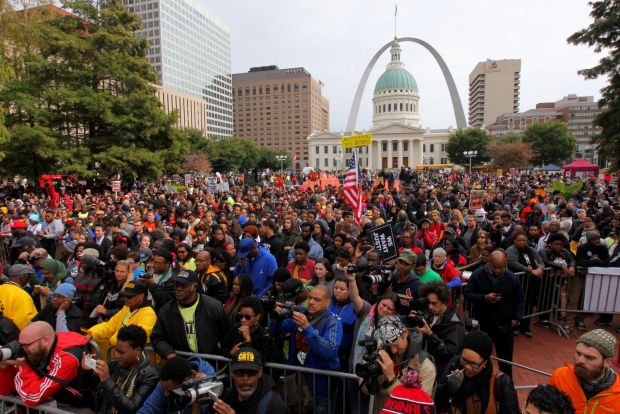 |
| Kiener Plaza, St Louis, MO |
The crowd gets a little more energized. Some people start rapping along. I listen along for a while, then I look around me and observe the physical space we are occupying, and recognize this space as a product of the music.
Woop-woop, that's the sound of da police
Woop-woop, that's the sound of da beast
You need a little clarity, check the similarityThe lyrics are clever, the WHOOP is catchy. KRS-One is taking his experiences and those of his community, and creating a work of art to share with them. Then, by replaying this work at the rally, the community is creating physical space for themselves.
The overseer rode around the plantation
The officer is off, patrolling all the nation
The overseer could stop you what you're doing
The officer will pull you over just when he's pursuing
The police them have a little gunThe physical boundaries of this community space has been delineated by the audible range of the lyrics. Anyone within the space who can hear it will be confronted with its charged message - those who identify with it can stay and share their common values with others, and those who find it hostile to themselves can tolerate their awkward outsider status or leave.
So when I'm on the streets, I walk around with a bigger one
KRS One - Sound of Da Police
Chants of protesters and activists have frequently been borrowed from rap, and vice versa. "No justice, no peace!" we shout. Then the artists go to their studios and create lyrics that expand their message.
Warrior Minded feat. Dramatik - No Justice, No Peace
Similarly, people on the streets draw from popular songs for their chants, such as when protesters reminded each other “We gon’ be alright.”
Protesters Chanting Lyrics
Kendrick Lamar - Alright
Rap has always been a way to create community space and convey narratives of shared experiences. I'll leave the details to the experts, but here are a few more examples I highly recommend you experience:
Queen Latifah, Yo-Yo, Lisa 'Left Eye' Lopes (of TLC), MC Lyte, Patra, Nefertiti, Da 5 Footaz, Salt-N-Pepa, Meshell Ndegeocello and others... the song was a tribute to women of the past like Harriet Tubman, Sojourner Truth, Rosa Parks, Coretta Scott King, Shirley Chisholm, and Angela Davis who played major roles in black resistance, as well as the empowerment of women of the present.
Beyoncé - Ghost
Thoughts on capitalism being at odds with creativity.
Miss Bolivia ft. Rebeca Lane & Ali Gua Gua – Libre Atrevida y Loca
Featuring femmes of all sorts of gender expressions and filmed in Argentina, Guatemala, and Mexico (where Miss Bolivia, Lane, and Ali Gua Gua are from, respectively) .
Angel Haze - Same Love (remix of Macklemore & Ryan Lewis)
The only version of this song anyone ever needs to hear.
Saturday, August 8, 2015
Sexual Abuse as the Cis Norm for Sex Education
TW dysphoria and rape
Let's talk about how cis people have sexually abused me my entire life. FUN!
Being raped multiple times wasn't traumatic... so I felt for a while, only I'm now realizing this is an inversion of reality.
Being raped wasn't more traumatic than sex in general, not enough for me to notice a significant difference.
To understand why sex has historically been traumatic for me, we need to first look at what healthy sex looks like:
It requires informed consent and co-determination. I need to be aware of what is happening and have the ability to exercise bodily agency.
I, like many queer and trans folk, was raised to view penis-in-vagina as The Sex, and with zero acknowledgement that dysphoria is possible.
Every single person who had the opportunity to educate me, grossly neglected to de-center PIV or present other options for sex as equal.
The only context my vagina was mentioned was as either a source of magical Jesus powers, or as a source of profound sexual liberation.
It is especially important to note that every cis male partner I've had was actively pushing this repression/liberation sex binary for years.
I was actively taught to view my intense discomfort with vaginal stimulation (even in a loving caring context) as something that's fixable.
I was expected to change. Always me. Never the other person. Never the way society pushed their cis agenda.
Individual partners claimed to respect my desires to avoid certain contact, but would guilt me on how their "needs" were equally valid.
All of the sex-positivity cultural rhetoric was on their side as I was shamed for not being "good, giving, & game".
No one ever suggested even once that my feelings were normal or natural, and that their sexual pressure was the dysfunction.
Fact: informed consent is not possible when cis people have actively obstructed education on trans bodies and queer sex.
Fact: bodily agency and sexual co-determination is not possible in the midst of ongoing gaslighting.
Fact: cis-centered sex education is abusive, and cis people who aren't actively working to dismantle that are complicit in ongoing abuse.
Let's talk about how cis people have sexually abused me my entire life. FUN!
Being raped multiple times wasn't traumatic... so I felt for a while, only I'm now realizing this is an inversion of reality.
Being raped wasn't more traumatic than sex in general, not enough for me to notice a significant difference.
To understand why sex has historically been traumatic for me, we need to first look at what healthy sex looks like:
It requires informed consent and co-determination. I need to be aware of what is happening and have the ability to exercise bodily agency.
I, like many queer and trans folk, was raised to view penis-in-vagina as The Sex, and with zero acknowledgement that dysphoria is possible.
Every single person who had the opportunity to educate me, grossly neglected to de-center PIV or present other options for sex as equal.
The only context my vagina was mentioned was as either a source of magical Jesus powers, or as a source of profound sexual liberation.
It is especially important to note that every cis male partner I've had was actively pushing this repression/liberation sex binary for years.
I was actively taught to view my intense discomfort with vaginal stimulation (even in a loving caring context) as something that's fixable.
I was expected to change. Always me. Never the other person. Never the way society pushed their cis agenda.
Individual partners claimed to respect my desires to avoid certain contact, but would guilt me on how their "needs" were equally valid.
All of the sex-positivity cultural rhetoric was on their side as I was shamed for not being "good, giving, & game".
No one ever suggested even once that my feelings were normal or natural, and that their sexual pressure was the dysfunction.
Fact: informed consent is not possible when cis people have actively obstructed education on trans bodies and queer sex.
Fact: bodily agency and sexual co-determination is not possible in the midst of ongoing gaslighting.
Fact: cis-centered sex education is abusive, and cis people who aren't actively working to dismantle that are complicit in ongoing abuse.
Saturday, June 6, 2015
On the Not-Getting-It-ness of the "Socialized As" Objection
Thinking about "socialized as" narratives, and how they're often created by and/or twisted into the cis agenda. Even non-TERFs seem to have this idea that our sense of ourselves and our place in society is based on behavioral conditioning specific to the gender our parents/teachers/friends assumed we were. This can look like a lot of things, but Ember Assington and I had a chat about a specific example of childhood gender socialization: Christian sexual "purity".
No matter how loudly some Christians claim "no sex outside of marriage" applies to boys equally, they aren't fooling anyone here that it's really about controlling girls. Girls need to "save themselves", girls need to dress "modestly", and married women need to suddenly do a 180 and become sexually available (but on *his* terms).
Ember and I both got a heavy dose of this growing up. We both tried to peform to the best of our abilities, and we both knew which gender role everyone expected us to fulfill. But we didn't internalize those gendered messages they were attempting to target us with, not really.
I never really believed I had sinned when I had sex before marriage. It was fun! I was glad to finally express myself sexually. I knew I had to play "virgin" still, and yes, that in itself is oppression. However, I wasn't dealing with any guilt or shame because I was incapable of feeling like it really applied to me as a non-girl.
Ember's experience was, sadly, the inverse. All the "male socialization" in the world won't give a non-boy feelings of entitlement to girl's bodies or a sense of sexual autonomy. They instead deeply struggled with guilt and shame of "impurity", the natural result of being a girl under Christian patriarchy.
And that's just one aspect of what trans socialization really looks like, one drop in the bucket. We all have so many different experiences which are constantly being retroactively misgendered by cis society (even feminism). I hope for a day when our stories aren't estranged.
What are your stories?
No matter how loudly some Christians claim "no sex outside of marriage" applies to boys equally, they aren't fooling anyone here that it's really about controlling girls. Girls need to "save themselves", girls need to dress "modestly", and married women need to suddenly do a 180 and become sexually available (but on *his* terms).
Ember and I both got a heavy dose of this growing up. We both tried to peform to the best of our abilities, and we both knew which gender role everyone expected us to fulfill. But we didn't internalize those gendered messages they were attempting to target us with, not really.
I never really believed I had sinned when I had sex before marriage. It was fun! I was glad to finally express myself sexually. I knew I had to play "virgin" still, and yes, that in itself is oppression. However, I wasn't dealing with any guilt or shame because I was incapable of feeling like it really applied to me as a non-girl.
Ember's experience was, sadly, the inverse. All the "male socialization" in the world won't give a non-boy feelings of entitlement to girl's bodies or a sense of sexual autonomy. They instead deeply struggled with guilt and shame of "impurity", the natural result of being a girl under Christian patriarchy.
And that's just one aspect of what trans socialization really looks like, one drop in the bucket. We all have so many different experiences which are constantly being retroactively misgendered by cis society (even feminism). I hope for a day when our stories aren't estranged.
What are your stories?
Monday, February 9, 2015
"Coming Out" as an Ally
GLAAD recently came up with a campaign that we can use as a case study. They have since changed the wording to remove the problematic language we are responding to, but the Google search results still show the original text.

[Screencapture of Google search results. The page title reads "Come out as an LGBT Ally. Take the pledge" and the page preview reads "[A] is for Ally. Broadening acceptance of LGBT Americans requires the help of allies".]
This is a prime example of appropriation⁴ of trans/queer culture. I am not asexual, so I encourage you to learn more from the ace community themselves on why the A should stand for "asexual".⁵ Even if you find that inclusion debatable (and I most certainly do not), this case still highlights the problems with trying to include "ally" under the alphabet soup of queer/trans identity.
Ember Assington outlined an incomplete list of reasons why, in the GenderQueer Atheists group on Facebook:
1. Queer people don't need to be saved by cis-het people, they need to be liberated from the oppression imposed by cis-het people.
2. Allies are necessarily coming from a position of privilege, so there's nothing for them to be in the closet about. They are not being oppressed, so there's nothing for them to "come out" about.
3. Calling yourself an "ally" is meaningless. There are plenty of people who declare themselves allies, and then go on to say horrible, bigoted things.
4. "Ally" shouldn't be an identity; it should be a collection of actions that support and raise up oppressed people by centering those people and their liberation rather than speaking for them.
5. Talking about "coming out" as not-a-bigot seems to imply that bigotry is a default position, and simply not being a complete shitbag is worthy of praise, rather than just being what we should expect of all people.
One additional reason I'm so opposed to allies appropriating a letter within LGBTQIA⁶ and the narrative of "coming out", is that once they take this and make it theirs, our own use of those things have lost their significance as descriptors of our own unique experiences navigating cis/straight structures of power as trans/queer people. What is the significance of explicit Lesbian Gay Bi Trans Questioning⁷ Intersex Asexual solidarity, when our community must now be centered around straight/cis (ally) experience as well? How can "coming out" be an act of resistance against structural cis/straight oppression, when straight/cis (allies) are "coming out" as cis/straight allies?
It really shouldn't need to be said, but this isn't an anti-ally position. This isn't something that alienates straight/cis persons who make active efforts to enable queer/trans liberation.
Footnotes:
4. It should be pointed out, GLAAD themselves are not the ones doing the appropriation of "coming out", but rather enabling cis/straight persons to do so. Cultural Appreciation or Cultural Appropriation?
6. As to whether the alphabet soup itself should be perpetuated, that is a whole larger conversation.
7. I identify my sexual orientation as "questioning", so this is not limited to people who are seeking to resolve their questions with an eventual "coming out" as something else.
Subscribe to:
Posts (Atom)