Showing posts with label racism. Show all posts

Saturday, April 22, 2017

It's not just about the restrooms but because you all keep making it about the restrooms we can talk about that...

Presented to Celebrate Diversity 2017 in Warsaw, Indiana.

I stand with my young child and face two doors, knowing what I need can be found behind both, aware that choosing one over the other is to publicly declare my deepest political allegiances. I casually make my way through Door #1, hoping nobody will notice. “Sir” I look up, and realize she’s looking directly at me. I’ve been found out. “Sir, you want to be over there,” she commands as she points directly toward Door #2, valiantly defending the innocence of the flock of preschool girls we’re both surrounded by. We go into the other room without a fuss. My child peers into a nearby urinal with suspicion at its contents, then up at me. “Mommy, what-” I swiftly brush him into the nearest stall before he can utter any more incriminating words, not knowing how to explain to a preschooler that there is no Door #3 for people like me.

There is a chance that any time you or your loved ones enters a public restroom, that they could be sharing it with a sex offender.  Child molesters, voyeurs/exhibitionists, date rapists - these are all people who buy the same groceries as us, eat at the same restaurants as us, and fill up at the same gas stations as us.  If you were the type to be concerned about safety in public restrooms, and believed that legislation were an effective tool to protect restroom patrons, what could you do about this situation?  If your proposed response is to outlaw transgender people, you just might be Indiana Republican state Senator Jim Tomes. Bear with me, I’m quoting him verbatim: “What about the other sector of society of people that who have all through the decades women been using women’s restrooms and men been using men’s restrooms and kind of like that and kind of expect that level of privacy?”

Don’t worry about people who are actually predators and convicted sex offenders; the real danger has been me all along!  Nevermind that if there really were an epidemic of cross-dressing voyeurs peeping under bathroom stalls, Fox News would be plastering their mug shots all over scare pieces in a never-ending parade of shame.  Meanwhile, the true stories of abuse and violence against transgender folks in public spaces get pushed to the back pages of the news.


I don't like the men's restrooms because I'm not a man, I’m nonbinary. I am familiar with the women's restrooms, but I'm not a woman, and I raise far too many suspicions in there now for my comfort anyway. I have gotten very skilled at finding single-user restrooms wherever I go, but I will use the men's room now if it's urgent, and carry myself with the confidence of a mediocre white man in a generally successful attempt to blend in.

I’m disturbed by a trend lately, where some men gleefully plot for (or at least dream about) pushing themselves into women's restrooms in an attempt to get kicked out. Sometimes it’s cis men [“cisgender” means someone who is not transgender]. These cis men are attempting to “prove” that anyone can “fake” being trans simply by throwing on a dress. Sometimes it’s trans men posting selfies, and then "surprise! I have a vagina!" It's supposed to “prove” that they don't belong in women’s restrooms because they "look like a man". The problem is that all of this harms women. Many trans women are suspected of “faking” their genders and that's why these laws are being passed in the first place. They are enforced by targeting women who “look like men”, which hurts all women, trans and cis alike. Plus, at its most basic this trend an example of cis and trans men forcing their way past women’s stated boundaries in an attempt to intimidate them to get their own way. What if masculinity were used for justice instead of violence?

In many states, there has never been a law explicitly against using the "wrong" restroom.  So why after over 100 years of trans people in multi-user public restrooms - yes, we've always been using them, even if you didn't notice - why now do we suddenly have this deep and urgent need for laws to segregate and outlaw us?  Honestly, it's for the money.  This is a great way to scare people into donating money to the political campaign or advocacy organization of their choice.  I'm including pro-LGBT orgs here: many of them use fear tactics to profit from our situation too.

Even if laws were passed explicitly to protect people like me, we still wouldn't be safe.  Laws can only provide recourse against harms already caused, for those of us who can even afford legal action, but they don’t change the hearts and minds of those who act against us.  The fact is, we cannot be safe in a society that demands segregation.  I mean that in the fullest sense.  We cannot be safe in a society that demands “separate yet equal” restrooms.

Racial segregation dates back to 1849; the first separate gendered restroom ordinances came 40 years later, in 1887.  When you dig into the arguments presented when proposing these gendered restrictions over the past century, you will find that it wasn’t about protecting women from men, it especially wasn’t about protecting black women from white men, it was always about protecting white women from black men by demonizing blackness. Segregated restrooms have always been racist as well as sexist, and as such will always be unsafe.

I again want to make it very clear that the root of the violence against my people isn’t the laws, it’s the prevailing mentality of a society that accepts a certain order of things as “normal”, and anyone who deviates is deemed in need of correction. In a society where all genders were valid and deserving of equal recognition and protection, it would be unthinkable to demand some of us to hide ourselves while others flaunt your “normal” genders every chance you get. You accept gender segregation because you don’t see us as real people.

For example: a friend of mine on Facebook recently posted that she defended the right of trans women to use the women’s restroom alongside herself, but she wanted to ask all trans women to please place the seat down after they were finished. Several of her friends chimed in their complaints in the comments. I think they thought they were being cute, but the message was clear: normal women keep the seat down, fake women leave it up. It never occurred to them that if a trans woman leaves the seat up, then leaving the seat up is a normal way for women to use the toilet, because trans women are women, not objects for your scrutiny.

Separating us out as not normal, not like you, not fully people leaves us vulnerable even in places that aren’t segregated by gender, even in places designated specifically for us. Stonewall Inn, site of the Stonewall Riots of 1969, is famed as the birthplace of the modern gay rights movement. In March of last year, a transgender woman went into the single-user restroom of Stonewall Inn, and video surveillance shows a man following her in there, where he then attacked and raped her. There are no safe spaces for people who are deemed less than human.

Two years ago, I spent the weekend traveling the beautiful Ozarks of Missouri with my child and my transgender wife. We stopped at a gas station to fill up, and we needed a bathroom break. It was a tiny place with a single-user restroom on the exterior of the building, so we sat on the nearby bench to wait our turn. The man standing next in line before us refused to budge. Soon he was joined by another man, forming a barricade. A woman came out and begged him not to start anything, to just let us go. We quickly realized they were targeting us, refusing to let us access the single-user restroom, willing to escalate to violence if necessary. They didn’t see a family with a child. They didn’t see people. They just saw some deviants with fake genders. We will never be safe until we are real.

Monday, August 8, 2016

The Violence of Personal Preferences

I see a disturbing pattern in conversations from time to time.
Person targeted with violence and oppression: "This thing hurts me."
Person who isn't targeted the same way: "But it's my personal preference."
It is not only possible, but it is highly probable that your personal preferences were shaped by the same culture of violence that the targeted person wants to be free from.
It is not your fault that your personal preferences are ones which perpetuate violence; however it is your responsibility to reshape your own thoughts and actions to minimize your contribution to violence, and it is your fault if you make excuses instead of doing the hard work.
At no point do you need to explain your violent preferences to the targets of oppression. At no point do you need us to make you feel better for having them.

Tuesday, January 12, 2016

Rap is Creativity; Rap is Community

This blog post was written to fulfill an assignment for my college course Creativity & Community.

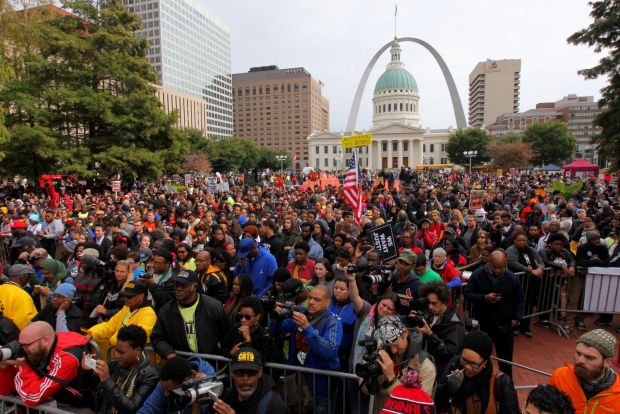
October of 2014, Ferguson October, we gathered in the lawn across from the courthouse, the place infamous for denying Dred Scott his personhood under the law.  We are rallying together to mourn what is lost and to build strength for what is possible.

Kiener Plaza, St Louis, MO

Woop-woop, that's the sound of da police
Woop-woop, that's the sound of da beast
The crowd gets a little more energized.  Some people start rapping along.  I listen along for a while, then I look around me and observe the physical space we are occupying, and recognize this space as a product of the music.
You need a little clarity, check the similarity
The overseer rode around the plantation
The officer is off, patrolling all the nation
The overseer could stop you what you're doing
The officer will pull you over just when he's pursuing
The lyrics are clever, the WHOOP is catchy.  KRS-One is taking his experiences and those of his community, and creating a work of art to share with them.  Then, by replaying this work at the rally, the community is creating physical space for themselves.
The police them have a little gun
So when I'm on the streets, I walk around with a bigger one
The physical boundaries of this community space has been delineated by the audible range of the lyrics.  Anyone within the space who can hear it will be confronted with its charged message - those who identify with it can stay and share their common values with others, and those who find it hostile to themselves can tolerate their awkward outsider status or leave.

KRS One - Sound of Da Police

Chants of protesters and activists have frequently been borrowed from rap, and vice versa.  "No justice, no peace!" we shout.  Then the artists go to their studios and create lyrics that expand their message.

Warrior Minded feat. Dramatik - No Justice, No Peace

Similarly, people on the streets draw from popular songs for their chants, such as when protesters reminded each other “We gon’ be alright.”

Protesters Chanting Lyrics

Kendrick Lamar - Alright

Rap has always been a way to create community space and convey narratives of shared experiences.  I'll leave the details to the experts, but here are a few more examples I highly recommend you experience:

Queen Latifah, Yo-Yo, Lisa 'Left Eye' Lopes (of TLC), MC Lyte, Patra, Nefertiti, Da 5 Footaz, Salt-N-Pepa, Meshell Ndegeocello and others... the song was a tribute to women of the past like Harriet Tubman, Sojourner Truth, Rosa Parks, Coretta Scott King, Shirley Chisholm, and Angela Davis who played major roles in black resistance, as well as the empowerment of women of the present.

Beyoncé - Ghost
Thoughts on capitalism being at odds with creativity.

Miss Bolivia ft. Rebeca Lane & Ali Gua Gua – Libre Atrevida y Loca
Featuring femmes of all sorts of gender expressions and filmed in Argentina, Guatemala, and Mexico (where Miss Bolivia, Lane, and Ali Gua Gua are from, respectively) .

Angel Haze - Same Love (remix of Macklemore & Ryan Lewis)
The only version of this song anyone ever needs to hear.

Saturday, August 31, 2013

Review: Godless Americana by Sikivu Hutchinson

Sikivu Hutchinson introduces Godless Americana as "a radical humanist analysis" that "provides a vision of secular social justice that challenges Eurocentric traditions of race, gender, and class-neutral secularism", and then spends the next 7 chapters doing exactly that. This book is a call to action, a vision of humanism that decentralizes the white experience and asks the reader to embrace a compassionate sense of initiative within their own sphere of influence.

Page after page, I found myself questioning my position on which issues humanism ought to prioritize, as this book brings up numerous examples of how centralizing the concerns of white secular Americans is to actively render humanism irrelevant to anyone who falls outside that territory. Perhaps most poignant moment was the day I had 2 extra hours to myself to read on the bus, due to my car being in the shop. As I sat there, surrounded by people for whom, unlike myself, this was not their back-up mode of transportation nor a temporary inconvenience, I read about the mobility gap: "Transit-dependency means isolation. It means less access to living-wage jobs, quality schools, affordable housing, and park space... whites generally live in white neighborhoods with greater access to social services, park spaces, and job centers."

How can the reader continue to practice a humanism that does not make efficient public transit a humanist issue; that does not make city planning a humanist issue; that does not make jobs, housing, education, and public health a humanist issue? This book is ready to answer every white-washed "we are all Africans" humanist who can't fathom why Americans of color run back to their churches for support from a Bible which advocates slavery, by questioning the very presumed innocence of whiteness itself. It boldly proclaims that a humanism that is not relevant to people of all races is quite simply irrelevant. I recommend this book for all humanists who have come to expect more from ourselves.

Tuesday, November 20, 2012

My TDoR will be intersectional or it will be BULLSHIT.


Sitting here shedding white tears because I haven't even finished my coffee yet and already been hit with 4 powerful reminders of how racism shits all over everything, and how fond society is to look away instead of clean our mess up.
NPR ran a couple good stories this morning: one on the lashback against the choice to cast a light-skinned Hollywood-approved Nina Simone, and another on the rising acceptance of black people as valid nerds. I did a little fist-pump (while trying not to swerve off the road) because I was glad to hear the momentum going in the right direction. Just a few minutes later, NPR addressed the pro-pot movement as it pertains to Colorado, and of course they didn't mention how white-washed that movement is nor how racist anti-marijuana law enforcement is, nobody ever does.
Today is the Transgender Day of Remembrance (TDoR) - I'm sure you've heard of it. Pay attention to how the remembered are portrayed. See how many times you see happy white faces (or worse: white man faces) as the focus of all the attention. Make no mistake: this is about race. Trans women are killed because of their race and often their association with sex work. "Whore! Pervert! No need for an investigation" and the case is closed.


Sunday, June 26, 2011

Bling vs Specs

This is something I wrote for class because I'm too school for cool.

Bling (aka Large Ornate Gold Necklaces/Jewelry)
We've all seen it: the ostentatious medallion hanging around the neck of a wealthy performance artist.

 image    image  

The name was popularized by a 1999 song with the title Bling-Bling.  The term "bling" refers to the bling-bling of light reflecting off the facets of the jewelry.  This is key - it must be ornate, gaudy, a blatant display of the economic power of the wearer.  Traditionally, blacks are seen as poor and lacking in social status, so the in-your-face consumerism of bling can be seen as an empowering reaction against such negative stereotypes.  This is known as conspicuous consumption. So why consume conspicuously?  Well, let's use bling as an example.  When we think of a middle-class white adolescent wearing bling, the reaction is probably something similar to this:

image
I noticed that you're gangster... I'm pretty gangster myself.
  

We mock people like that, because we see them as trying to pretend to be what they're not, aka a poser.  We wouldn't do that if stuff is just stuff, clothes are just clothes, and each individual has a unique style.  Conspicuous consumption isn't just about wealth and self-expression, it's about identifying with a particular social caste or sub-culture.  As social creatures, we not only have an individual identity, we have a group identity.  We subconsciously label ourselves, even those of us who reject labels, by how we dress.  The bling-laden white boy in the West County suburbs isn't showing pride in his identity, he's engaging in an insensitive type of conspicuous consumption known as cultural appropriation.

Specs (aka Hipster Glasses)
Hipsters are a group of people who typically don't identify themselves as being a collective group of people for the simple reason that they share a common distaste for personal labels.  They're the natural result of our cultural cult of individuality taken to the extreme.  As such, they reject conspicuous consumption because that could potentially cause them to be mistaken for a member of a particular social caste (a practice which often causes them to be so rejecting of any culture close to themselves that the only option they have left is severe and shameless cultural appropriation).  And for a while, they were successful at being beautiful and unique snowflakes.

But a funny thing happens when enough people reject the concept of social castes - they become a social caste of people who share that common rejection.  This is where hipster irony is born.


image 

Specs like these are nothing new, not at all.  Horn-rimmed glasses actually got their kick start in 1917 by actor Harry Lloyd.  They became rather popular in the 50s as well.  Some people never stopped wearing them.  So why do hipsters love them so?  Simple: they're ugly.  I mean, seriously.  They're so ugly, in the military they're known as BCGs - birth control glasses.  (They're the only style allowed at basic training [update: the military's policy has been changed since this paper was written].)

image 

(Tasty.)  Hipsters caught on to the extreme unpopularity of these glasses and began wearing them ironically, as a rejection of conspicuous consumption.  Only, it caught on and became popular among the totally-not-at-all-affiliated-with-each-other hipsters themselves, and became a "hipster thing", to the point where it's now it's own meme.  That's right, you can take any image, add glasses, and it's instantly hipster.

image
I'm the biggest thing ever - I'm only being a hipster ironically.


"A hipster can be so emphatically, conspicuously hipster that he becomes a predictable caricature or stereotype so that he becomes, unwittingly, anti-hipster."  Ironic, isn't it?