Content note: bathroom bills, transmisogyny, violation of boundaries (any others?)
I don't like the men's restrooms because I'm not a man, I’m nonbinary. I am familiar with the women's restrooms, but I'm not a woman, and I raise far too many suspicions in there now for my comfort anyway. I have gotten very skilled at finding single-user restrooms wherever I go, but I use the men's room now if it's urgent and carry myself with the confidence of a mediocre white man in a generally successful attempt to blend in.
I’m disturbed by a trend lately, where men gleefully plot for (or at least dream about) pushing themselves into women's restrooms to get kicked out, sometimes posting selfies, and then "surprise! I have a vagina because I'm trans!" It's supposed to "disprove" oppressive bathroom bills, by showing that they don't belong in women’s restrooms because they "look like a man".
The problem is that this harms women. Many trans women are suspected of "looking like a man" and that's why these laws are being passed in the first place. Plus, at its most basic this is an example of men forcing their way past [trans and cis] women’s stated boundaries. What if masculinity were used for justice instead of violence?
To the white boys out there interrupting the conversation with your “but what about?”: There's a key difference between "using the women's restroom to get noticed" and "using the women's restroom to avoid being noticed". I understand as well as any trans person that as long as restrooms are segregated, none of us are really safe. But please join me in working against transmisogyny in our words and actions.
Showing posts with label appropriation. Show all posts
Showing posts with label appropriation. Show all posts
Tuesday, April 4, 2017

Tuesday, January 12, 2016
Rap is Creativity; Rap is Community
This blog post was written to fulfill an assignment for my college course Creativity & Community.
October of 2014, Ferguson October, we gathered in the lawn across from the courthouse, the place infamous for denying Dred Scott his personhood under the law. We are rallying together to mourn what is lost and to build strength for what is possible.
Chants of protesters and activists have frequently been borrowed from rap, and vice versa. "No justice, no peace!" we shout. Then the artists go to their studios and create lyrics that expand their message.
Similarly, people on the streets draw from popular songs for their chants, such as when protesters reminded each other “We gon’ be alright.”
Rap has always been a way to create community space and convey narratives of shared experiences. I'll leave the details to the experts, but here are a few more examples I highly recommend you experience:
October of 2014, Ferguson October, we gathered in the lawn across from the courthouse, the place infamous for denying Dred Scott his personhood under the law. We are rallying together to mourn what is lost and to build strength for what is possible.
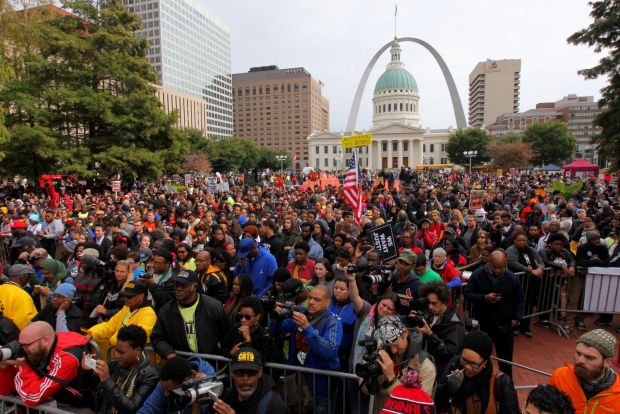 |
| Kiener Plaza, St Louis, MO |
The crowd gets a little more energized. Some people start rapping along. I listen along for a while, then I look around me and observe the physical space we are occupying, and recognize this space as a product of the music.
Woop-woop, that's the sound of da police
Woop-woop, that's the sound of da beast
You need a little clarity, check the similarityThe lyrics are clever, the WHOOP is catchy. KRS-One is taking his experiences and those of his community, and creating a work of art to share with them. Then, by replaying this work at the rally, the community is creating physical space for themselves.
The overseer rode around the plantation
The officer is off, patrolling all the nation
The overseer could stop you what you're doing
The officer will pull you over just when he's pursuing
The police them have a little gunThe physical boundaries of this community space has been delineated by the audible range of the lyrics. Anyone within the space who can hear it will be confronted with its charged message - those who identify with it can stay and share their common values with others, and those who find it hostile to themselves can tolerate their awkward outsider status or leave.
So when I'm on the streets, I walk around with a bigger one
KRS One - Sound of Da Police
Chants of protesters and activists have frequently been borrowed from rap, and vice versa. "No justice, no peace!" we shout. Then the artists go to their studios and create lyrics that expand their message.
Warrior Minded feat. Dramatik - No Justice, No Peace
Similarly, people on the streets draw from popular songs for their chants, such as when protesters reminded each other “We gon’ be alright.”
Protesters Chanting Lyrics
Kendrick Lamar - Alright
Rap has always been a way to create community space and convey narratives of shared experiences. I'll leave the details to the experts, but here are a few more examples I highly recommend you experience:
Queen Latifah, Yo-Yo, Lisa 'Left Eye' Lopes (of TLC), MC Lyte, Patra, Nefertiti, Da 5 Footaz, Salt-N-Pepa, Meshell Ndegeocello and others... the song was a tribute to women of the past like Harriet Tubman, Sojourner Truth, Rosa Parks, Coretta Scott King, Shirley Chisholm, and Angela Davis who played major roles in black resistance, as well as the empowerment of women of the present.
Beyoncé - Ghost
Thoughts on capitalism being at odds with creativity.
Miss Bolivia ft. Rebeca Lane & Ali Gua Gua – Libre Atrevida y Loca
Featuring femmes of all sorts of gender expressions and filmed in Argentina, Guatemala, and Mexico (where Miss Bolivia, Lane, and Ali Gua Gua are from, respectively) .
Angel Haze - Same Love (remix of Macklemore & Ryan Lewis)
The only version of this song anyone ever needs to hear.
Monday, February 9, 2015
"Coming Out" as an Ally
GLAAD recently came up with a campaign that we can use as a case study. They have since changed the wording to remove the problematic language we are responding to, but the Google search results still show the original text.

[Screencapture of Google search results. The page title reads "Come out as an LGBT Ally. Take the pledge" and the page preview reads "[A] is for Ally. Broadening acceptance of LGBT Americans requires the help of allies".]
This is a prime example of appropriation⁴ of trans/queer culture. I am not asexual, so I encourage you to learn more from the ace community themselves on why the A should stand for "asexual".⁵ Even if you find that inclusion debatable (and I most certainly do not), this case still highlights the problems with trying to include "ally" under the alphabet soup of queer/trans identity.
Ember Assington outlined an incomplete list of reasons why, in the GenderQueer Atheists group on Facebook:
1. Queer people don't need to be saved by cis-het people, they need to be liberated from the oppression imposed by cis-het people.
2. Allies are necessarily coming from a position of privilege, so there's nothing for them to be in the closet about. They are not being oppressed, so there's nothing for them to "come out" about.
3. Calling yourself an "ally" is meaningless. There are plenty of people who declare themselves allies, and then go on to say horrible, bigoted things.
4. "Ally" shouldn't be an identity; it should be a collection of actions that support and raise up oppressed people by centering those people and their liberation rather than speaking for them.
5. Talking about "coming out" as not-a-bigot seems to imply that bigotry is a default position, and simply not being a complete shitbag is worthy of praise, rather than just being what we should expect of all people.
One additional reason I'm so opposed to allies appropriating a letter within LGBTQIA⁶ and the narrative of "coming out", is that once they take this and make it theirs, our own use of those things have lost their significance as descriptors of our own unique experiences navigating cis/straight structures of power as trans/queer people. What is the significance of explicit Lesbian Gay Bi Trans Questioning⁷ Intersex Asexual solidarity, when our community must now be centered around straight/cis (ally) experience as well? How can "coming out" be an act of resistance against structural cis/straight oppression, when straight/cis (allies) are "coming out" as cis/straight allies?
It really shouldn't need to be said, but this isn't an anti-ally position. This isn't something that alienates straight/cis persons who make active efforts to enable queer/trans liberation.
Footnotes:
4. It should be pointed out, GLAAD themselves are not the ones doing the appropriation of "coming out", but rather enabling cis/straight persons to do so. Cultural Appreciation or Cultural Appropriation?
6. As to whether the alphabet soup itself should be perpetuated, that is a whole larger conversation.
7. I identify my sexual orientation as "questioning", so this is not limited to people who are seeking to resolve their questions with an eventual "coming out" as something else.
Subscribe to:
Posts (Atom)