Showing posts with label social justice. Show all posts

Saturday, April 22, 2017

It's not just about the restrooms but because you all keep making it about the restrooms we can talk about that...

Presented to Celebrate Diversity 2017 in Warsaw, Indiana.

I stand with my young child and face two doors, knowing what I need can be found behind both, aware that choosing one over the other is to publicly declare my deepest political allegiances. I casually make my way through Door #1, hoping nobody will notice. “Sir” I look up, and realize she’s looking directly at me. I’ve been found out. “Sir, you want to be over there,” she commands as she points directly toward Door #2, valiantly defending the innocence of the flock of preschool girls we’re both surrounded by. We go into the other room without a fuss. My child peers into a nearby urinal with suspicion at its contents, then up at me. “Mommy, what-” I swiftly brush him into the nearest stall before he can utter any more incriminating words, not knowing how to explain to a preschooler that there is no Door #3 for people like me.

There is a chance that any time you or your loved ones enters a public restroom, that they could be sharing it with a sex offender.  Child molesters, voyeurs/exhibitionists, date rapists - these are all people who buy the same groceries as us, eat at the same restaurants as us, and fill up at the same gas stations as us.  If you were the type to be concerned about safety in public restrooms, and believed that legislation were an effective tool to protect restroom patrons, what could you do about this situation?  If your proposed response is to outlaw transgender people, you just might be Indiana Republican state Senator Jim Tomes. Bear with me, I’m quoting him verbatim: “What about the other sector of society of people that who have all through the decades women been using women’s restrooms and men been using men’s restrooms and kind of like that and kind of expect that level of privacy?”

Don’t worry about people who are actually predators and convicted sex offenders; the real danger has been me all along!  Nevermind that if there really were an epidemic of cross-dressing voyeurs peeping under bathroom stalls, Fox News would be plastering their mug shots all over scare pieces in a never-ending parade of shame.  Meanwhile, the true stories of abuse and violence against transgender folks in public spaces get pushed to the back pages of the news.


I don't like the men's restrooms because I'm not a man, I’m nonbinary. I am familiar with the women's restrooms, but I'm not a woman, and I raise far too many suspicions in there now for my comfort anyway. I have gotten very skilled at finding single-user restrooms wherever I go, but I will use the men's room now if it's urgent, and carry myself with the confidence of a mediocre white man in a generally successful attempt to blend in.

I’m disturbed by a trend lately, where some men gleefully plot for (or at least dream about) pushing themselves into women's restrooms in an attempt to get kicked out. Sometimes it’s cis men [“cisgender” means someone who is not transgender]. These cis men are attempting to “prove” that anyone can “fake” being trans simply by throwing on a dress. Sometimes it’s trans men posting selfies, and then "surprise! I have a vagina!" It's supposed to “prove” that they don't belong in women’s restrooms because they "look like a man". The problem is that all of this harms women. Many trans women are suspected of “faking” their genders and that's why these laws are being passed in the first place. They are enforced by targeting women who “look like men”, which hurts all women, trans and cis alike. Plus, at its most basic this trend an example of cis and trans men forcing their way past women’s stated boundaries in an attempt to intimidate them to get their own way. What if masculinity were used for justice instead of violence?

In many states, there has never been a law explicitly against using the "wrong" restroom.  So why after over 100 years of trans people in multi-user public restrooms - yes, we've always been using them, even if you didn't notice - why now do we suddenly have this deep and urgent need for laws to segregate and outlaw us?  Honestly, it's for the money.  This is a great way to scare people into donating money to the political campaign or advocacy organization of their choice.  I'm including pro-LGBT orgs here: many of them use fear tactics to profit from our situation too.

Even if laws were passed explicitly to protect people like me, we still wouldn't be safe.  Laws can only provide recourse against harms already caused, for those of us who can even afford legal action, but they don’t change the hearts and minds of those who act against us.  The fact is, we cannot be safe in a society that demands segregation.  I mean that in the fullest sense.  We cannot be safe in a society that demands “separate yet equal” restrooms.

Racial segregation dates back to 1849; the first separate gendered restroom ordinances came 40 years later, in 1887.  When you dig into the arguments presented when proposing these gendered restrictions over the past century, you will find that it wasn’t about protecting women from men, it especially wasn’t about protecting black women from white men, it was always about protecting white women from black men by demonizing blackness. Segregated restrooms have always been racist as well as sexist, and as such will always be unsafe.

I again want to make it very clear that the root of the violence against my people isn’t the laws, it’s the prevailing mentality of a society that accepts a certain order of things as “normal”, and anyone who deviates is deemed in need of correction. In a society where all genders were valid and deserving of equal recognition and protection, it would be unthinkable to demand some of us to hide ourselves while others flaunt your “normal” genders every chance you get. You accept gender segregation because you don’t see us as real people.

For example: a friend of mine on Facebook recently posted that she defended the right of trans women to use the women’s restroom alongside herself, but she wanted to ask all trans women to please place the seat down after they were finished. Several of her friends chimed in their complaints in the comments. I think they thought they were being cute, but the message was clear: normal women keep the seat down, fake women leave it up. It never occurred to them that if a trans woman leaves the seat up, then leaving the seat up is a normal way for women to use the toilet, because trans women are women, not objects for your scrutiny.

Separating us out as not normal, not like you, not fully people leaves us vulnerable even in places that aren’t segregated by gender, even in places designated specifically for us. Stonewall Inn, site of the Stonewall Riots of 1969, is famed as the birthplace of the modern gay rights movement. In March of last year, a transgender woman went into the single-user restroom of Stonewall Inn, and video surveillance shows a man following her in there, where he then attacked and raped her. There are no safe spaces for people who are deemed less than human.

Two years ago, I spent the weekend traveling the beautiful Ozarks of Missouri with my child and my transgender wife. We stopped at a gas station to fill up, and we needed a bathroom break. It was a tiny place with a single-user restroom on the exterior of the building, so we sat on the nearby bench to wait our turn. The man standing next in line before us refused to budge. Soon he was joined by another man, forming a barricade. A woman came out and begged him not to start anything, to just let us go. We quickly realized they were targeting us, refusing to let us access the single-user restroom, willing to escalate to violence if necessary. They didn’t see a family with a child. They didn’t see people. They just saw some deviants with fake genders. We will never be safe until we are real.

Sunday, November 20, 2016

Suffering as Social Capital

I see a dangerous idea circulating: the idea of suffering as social capital.

I see it in the way many will regard suffering to be the determining factor for transness: more suffering/dysphoria = more trans; the most true form of transness being death itself. (Glares at truscum.)

I see it in activist circles too, the idea that the more you suffer for The Cause, the more radical you are. Isn't the perk of socialism that it does not demand equal labor from all people? We seek liberation. Why would we replicate the destructive approach to get there that capitalism offers? Why would we demand those with different abilities to perform the same productivity or else deem they be accorded less liberation?

Sometimes it feels like everything is violence and hate and it becomes overwhelming. Then a friend talks about how they made pudding, and I can be a little more okay. I need that connection with others. I need solidarity. People on Facebook are what keeps me going, are part of what fuels the revolution. If there's no room for people who can post things on Facebook and make pudding, stop the bus and let me off, I will take no part of this fake socialism.

Tuesday, January 12, 2016

Rap is Creativity; Rap is Community

This blog post was written to fulfill an assignment for my college course Creativity & Community.

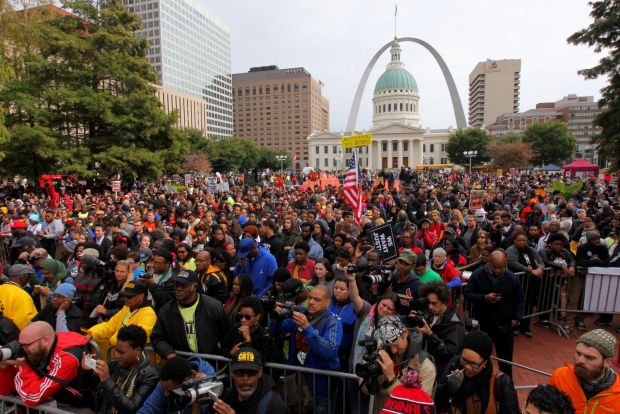
October of 2014, Ferguson October, we gathered in the lawn across from the courthouse, the place infamous for denying Dred Scott his personhood under the law.  We are rallying together to mourn what is lost and to build strength for what is possible.

Kiener Plaza, St Louis, MO

Woop-woop, that's the sound of da police
Woop-woop, that's the sound of da beast
The crowd gets a little more energized.  Some people start rapping along.  I listen along for a while, then I look around me and observe the physical space we are occupying, and recognize this space as a product of the music.
You need a little clarity, check the similarity
The overseer rode around the plantation
The officer is off, patrolling all the nation
The overseer could stop you what you're doing
The officer will pull you over just when he's pursuing
The lyrics are clever, the WHOOP is catchy.  KRS-One is taking his experiences and those of his community, and creating a work of art to share with them.  Then, by replaying this work at the rally, the community is creating physical space for themselves.
The police them have a little gun
So when I'm on the streets, I walk around with a bigger one
The physical boundaries of this community space has been delineated by the audible range of the lyrics.  Anyone within the space who can hear it will be confronted with its charged message - those who identify with it can stay and share their common values with others, and those who find it hostile to themselves can tolerate their awkward outsider status or leave.

KRS One - Sound of Da Police

Chants of protesters and activists have frequently been borrowed from rap, and vice versa.  "No justice, no peace!" we shout.  Then the artists go to their studios and create lyrics that expand their message.

Warrior Minded feat. Dramatik - No Justice, No Peace

Similarly, people on the streets draw from popular songs for their chants, such as when protesters reminded each other “We gon’ be alright.”

Protesters Chanting Lyrics

Kendrick Lamar - Alright

Rap has always been a way to create community space and convey narratives of shared experiences.  I'll leave the details to the experts, but here are a few more examples I highly recommend you experience:

Queen Latifah, Yo-Yo, Lisa 'Left Eye' Lopes (of TLC), MC Lyte, Patra, Nefertiti, Da 5 Footaz, Salt-N-Pepa, Meshell Ndegeocello and others... the song was a tribute to women of the past like Harriet Tubman, Sojourner Truth, Rosa Parks, Coretta Scott King, Shirley Chisholm, and Angela Davis who played major roles in black resistance, as well as the empowerment of women of the present.

Beyoncé - Ghost
Thoughts on capitalism being at odds with creativity.

Miss Bolivia ft. Rebeca Lane & Ali Gua Gua – Libre Atrevida y Loca
Featuring femmes of all sorts of gender expressions and filmed in Argentina, Guatemala, and Mexico (where Miss Bolivia, Lane, and Ali Gua Gua are from, respectively) .

Angel Haze - Same Love (remix of Macklemore & Ryan Lewis)
The only version of this song anyone ever needs to hear.

Monday, February 9, 2015

"Coming Out" as an Ally

Much has been written about what the responsibilities of allies are,¹ and how calling oneself an ally doesn't preclude one from participating in the same oppression as openly bigoted persons.²  In fact, many people discourage themselves and others from using "ally" as a self-appointed label at all.³

GLAAD recently came up with a campaign that we can use as a case study.  They have since changed the wording to remove the problematic language we are responding to, but the Google search results still show the original text.

[Screencapture of Google search results. The page title reads "Come out as an LGBT Ally. Take the pledge" and the page preview reads "[A] is for Ally. Broadening acceptance of LGBT Americans requires the help of allies".]

This is a prime example of appropriation⁴ of trans/queer culture.  I am not asexual, so I encourage you to learn more from the ace community themselves on why the A should stand for "asexual".⁵  Even if you find that inclusion debatable (and I most certainly do not), this case still highlights the problems with trying to include "ally" under the alphabet soup of queer/trans identity.

Ember Assington outlined an incomplete list of reasons why, in the GenderQueer Atheists group on Facebook:

1. Queer people don't need to be saved by cis-het people, they need to be liberated from the oppression imposed by cis-het people.

2. Allies are necessarily coming from a position of privilege, so there's nothing for them to be in the closet about. They are not being oppressed, so there's nothing for them to "come out" about.

3. Calling yourself an "ally" is meaningless. There are plenty of people who declare themselves allies, and then go on to say horrible, bigoted things.

4. "Ally" shouldn't be an identity; it should be a collection of actions that support and raise up oppressed people by centering those people and their liberation rather than speaking for them.

5. Talking about "coming out" as not-a-bigot seems to imply that bigotry is a default position, and simply not being a complete shitbag is worthy of praise, rather than just being what we should expect of all people.

One additional reason I'm so opposed to allies appropriating a letter within LGBTQIA⁶ and the narrative of "coming out", is that once they take this and make it theirs, our own use of those things have lost their significance as descriptors of our own unique experiences navigating cis/straight structures of power as trans/queer people.  What is the significance of explicit Lesbian Gay Bi Trans Questioning⁷ Intersex Asexual solidarity, when our community must now be centered around straight/cis (ally) experience as well?  How can "coming out" be an act of resistance against structural cis/straight oppression, when straight/cis (allies) are "coming out" as cis/straight allies?

It really shouldn't need to be said, but this isn't an anti-ally position.  This isn't something that alienates straight/cis persons who make active efforts to enable queer/trans liberation.


Footnotes:
4. It should be pointed out, GLAAD themselves are not the ones doing the appropriation of "coming out", but rather enabling cis/straight persons to do so.  Cultural Appreciation or Cultural Appropriation?
6. As to whether the alphabet soup itself should be perpetuated, that is a whole larger conversation.
7. I identify my sexual orientation as "questioning", so this is not limited to people who are seeking to resolve their questions with an eventual "coming out" as something else.

Friday, June 27, 2014

How I Process Others' Anger on the Internet

One thing I've learned from a wide variety of sources, including those who practice mindfulness meditation and some social justice advocates, is acknowledging and experiencing emotion without judgement. Primarily, this is to be used as an act of self-awareness and can be an integral part of radical self-acceptance. What I do is I pause for a moment, take an inventory of all the emotions and sensations I am experiencing, consciously state to myself "I am feeling anxious, my heart is racing, this is a physical state of being, it is valid for me to feel, it will pass, it will not overcome me, I do not feel okay, it is okay to not feel okay, I will be okay*". I could do this with a variety of emotions and sensations, but I primarily use it to manage the symptoms of my anxiety. (Note: it doesn't make my anxiety go away, it simply eliminates the meta-anxiety, the anxieties I get about my anxieties.)

In learning to treat myself this way, I've gained enough skill to be able to treat others in this way too. Sometimes I don't have the energy, because self-care comes first. When I do have the energy, it allows me to experience the extreme emotions of others as a necessary part of their humanity. Or, to flip it, to avoid dehumanizing others by making their emotions out to be something they owe me.

So, sometimes when I'm reading things that are rather extreme in their anger or bitterness, assuming I do have the spare energy to deal with it at the time, I'll guide myself through my reaction to their feelings similarly. "This person's tone strikes me as bitter, this is an emotion they are experiencing, I am privileged to be able to see into their experiences, their emotions are a valid part of who they are, their actions are not their emotions nor are their emotions their actions, I can learn from their experiences." It helps me absorb the entire message, especially in those more difficult situations where I'm apt to take things personally (such as when people of color call out the BS white people do, and I recognize I'm included in the target demographic).  I definitely could use way more practice at this, but it's a worthwhile skill that has enriched my existence thus far.

*Well... until I die one day. Eventually. :-P

Monday, December 30, 2013

The Grace to Become our Better Selves

I believe in something greater than myself.
A better world.
A world without sin.

So me and mine gotta lay down and die...
so you can live in your better world?

I'm not going to live there.
There's no place for me there...
any more than there is for you. Malcolm...
I'm a monster.
What I do is evil.
I have no illusions about it, but it must be done.

Serenity (2005): the Operative calls Mal

The remarkable thing about self-justification is that it allows us to shift from one role to the other and back again in the blink of an eye, without applying what we have learned from one role to the next.  Feeling like a victim of injustice in one situation does not make us less likely to commit an injustice against someone else, nor does it make us more sympathetic to victims.  It's as if there is a brick wall between those two sets of experiences, blocking our ability to see the other side.  Carol Tavris and Elliot Aronson, Mistakes Were Made (But Not by Me), page 192¹

"We back people into corners, and don't give them the grace to become their better selves." ~Me²
"Oh, that is just so cute!"  ~James Croft


I have no interest in being one of the Good Ones.  I'm not your model minority.  This terrible bargain I have regretfully struck often leads me to situations where I don't have any beneficial doubts left to give.  So how then did I arrive here in this space, contemplating the ways in which the social justice community has utterly let us down?


I have had to block a grand total of 3 people on Facebook for harassing me in private messages which they initiated.  I consider myself lucky that it's only 3, as I know of people for whom that is their daily minimum.  One was a guy who said he had a crush on me, and when I didn't respond quickly enough³, he gave me a lecture on how I owed him a response.  Another guy I had to block was actually e-stalking me, after I posted a smart-ass comment on his blog where he declared his intent to quit blogging if one more feminist complained about "sexism in atheism" [spoiler: he didn't quit blogging].

But the one that actually made my jaw drop was no entitled jerk-butt dude, she was a social justice activist.  I had shared two things on Facebook which she objected to.  I understand why she objected, and I myself would not share them today.  What happened with her was such a flurry I could barely keep track of what was happening at the time, but I still remember it vividly.  I had been working, and when I got the time to check back into Facebook, there were 75 comments on the offending post, and half of them was this woman calling me (and anyone else who wandered in) a bigot.  There were also several private messages from her that were taking me to task.  I tried having a conversations with her about the matter over the following day or so, but I quite obviously didn't have the time or energy she did to keep up with the vitriol she was throwing at me and everyone else on my page, so I blocked her too.

What really stuck with me though was the way she made it quite clear that she saw her role in all of this as being my punisher.  She wasn't trying to educate me or anyone else there about why Everybody Draw Mohammed Day can be Islamophobic, nor did she ever ask whether I knew RadFem Hub⁴ was transmisogynist (again, things I now know better about).  She put minimal effort into showing concern for the harmful effects our actions would have on actual Muslims or trans people.  She didn't even want an apology or for me to make a good-faith effort toward fixing the situation or changing my ways for the better.  No, what she demanded most was for us adapt her perspective that we are bad people.


I don't share this story so that you feel sorry for me, or outraged at Those Social Justice Activists™ (after all, I did eventually figure out what she was ranting about, and learned a thing or two).  The reason this sticks with me even today isn't for throwing a perpetual pity party⁵.  It's that I realized through her behavior I was being granted a vision of my own SJ future; there, but for the grace I grant humanity, go I.  And much like Ebeneezer Scrooge, I saw how easily I could become that person myself.

This isn't to say that I can just blow smoke up my own ass and everything will be okay.  Obviously, if all it took for us to be granted our equal rights in society was for us to ask politely, we'd have equality by now.  But I also know that the act of expressing anger is not without negative health effects on my own physical body.  As a humanist, I know that I only get one life.  This is it.  I want to spend it making the world a better place for others, but I am unwilling to destroy myself in the process.  Self-care is not selfish.

This is where the social justice community has failed me, and many others like me.  There are entire guides to calling others out and checking your own privilege and being a good ally.  I do not, however, see a doctrine of transformative grace.

What I need, what so many of us need, are the tools to become our better selves, and the social support to explore what this means for ourselves without being cut down at our first faltering steps.  For example, even though there is no obligation for anyone to forgive their oppressor, some of us may want access to and support using the tools we need to let go of bitterness before it burns us to ashes from within⁶.  But when we speak out about this aspect of our mental/emotional health, we're quickly shot down with reminders of how our needs aren't politically convenient to the social justice narrative.  We're told that we're accepting blame on ourselves as individuals that should be placed on society, that we're reinforcing the status quo - a perversion of "the personal is political".


I keep holding off on publishing this, waiting for inspiration to recall that perfect real-world example from my past that will bring tears to my readers' eyes, or write that perfect closing paragraph to revolutionize the social justice community.  And of course I won't, because I'm just some humanist with uncomfortable ideals and inconvenient life experiences, and this is a blog with 3 followers.  So to all 3 of you, I leave you with this quote, which I rather like, but couldn't quite find a way to insert it into the blog post without an awkward transition, thusly:

Clinical psychologists Andrew Christensen and Neil Jacobson described three possible ways out of the emotional impasse.  ...    If it is only the perpetrator who apologizes and tries to atone, it may not be done honestly or in a way that assuages and gives closure to the victim's suffering.  But if it is only the victim who lets go and forgives, the perpetrator may have no incentive to change, and therefore may continue behaving unfairly or callously.  ...  The third way, they suggest, is the hardest but most hopeful for a long-term resolution to the conflict: Both sides drop their self-justifications and agree on steps they can take together to move forward.  Carol Tavris and Elliot Aronson, Mistakes Were Made (But Not by Me), page 210


Let us grant each other the grace to become our better selves.


Edit 1/26/14: I figured if I kept my eyes open, I'd find some other people saying similar things to what I'm saying, and sure enough here are a couple good blog posts:

Calling IN: A Less Disposable Way of Holding Each Other Accountable by Ngọc Loan Trần

On cynicism, calling out, and creating movements that don’t leave our people behind by Verónica Bayetti Flores


Footnotes:
1. I highly encourage you to click that link and continue to read, as they describe an experiment wherein people generally rate the pain caused to themselves as more severe than the same degree of pain they themselves cause to others.
2. Regarding the Ron Lindsey mansplains the entire Women In Secularism 2 conference incident of June 2013.
3. I didn't save the convo, but here's one a friend recently had that was rather similar, except hers was even worse than mine.
4. That's a no-follow link, I'm willing to increase their hit counts.  Fortunately, the original RadFem Hub is no longer on the internet, but they managed to save plenty of their horribleness in their new archives.
5. Referencing note #3, I have friends who experience worse on a daily basis. Fuck yeah, Patriarchy!
6. As always, the person who wrote the CNN headline didn't bother to read the article.  But you should read the entire thing through.