Wednesday, February 17, 2016

Preventing Rape

This blog post was written to fulfill an assignment for the course Creativity & Community.

Everyone at IPFW has to take a rape prevention course, and that's what this post is responding to.  This post is going to cover some heavy topics, including abuse, rape, and (gasp!) my sex life.  If that sounds like too much for you, check out these cute bunnies instead: http://dailybunny.org/ (Seriously, they are adorable.)

My commitment to sexual safety and well-being begins with me.  I love my girlfriend very much, and that love is unconditional.  What I mean by that is, if they don't want to do something, we don't do it.  At all.  Maybe they don't want to have sex for a week, a month, a year, ever?  That's okay.  I'd honestly rather have no sex than bad sex.  I'd rather see their smiling face every morning, than guilt them into reluctant sex and the hurt feelings that follow.  I know they feel the same in return.

We both are rape survivors.  One day I was one of those people who had never been raped, and the next I was asking my husband why he didn't listen to my demands to stop hurting me.  (Protip: there's no good answer to that question.)  My girlfriend's stories are their own, but were based in an incorrect belief that certain people with certain anatomy are incapable of being raped.  My experiences with sexual violence don't define me, but they were difficult parts of my life, and I would never want to make anyone else feel the way I felt.

I already mentioned one way I am committed to a nonviolent approach to relationships: sex is always a benefit of, not a condition for, relationships.  Some other principles I carry with me are a constant checking in with my partner for how they're feeling.  Do you like what I'm doing?  Is there something you'd prefer instead?  Talk!  Be prepared at any moment to switch to cuddles and reassurance.

I need to have a healthy sexual relationship with... myself.  Quite frankly, if I want something done right, I can do it myself.  There's no shame in that, and a healthy relationship partner will recognize that.  Nobody has the right to pressure me to put an end to "me time", and I have no right to pressure anyone else to press pause on their own sexual relationship with themself either.  So if I don't need someone else to get the job done for me, that means I can focus on what is healthy and fun for all of us.

Even though this blog post was about sexual responsibility in particular, these sorts of caring behaviors can be applied to many different aspects of relationships.  For example, just as I have no right to make sexual decisions for my partner(s), I have no right to make other relationship decisions for them either.  I have a tendency to run a tight schedule, and when I neglect to consult my girlfriend on their time and attention needs, they are left out and hurt by the decisions I have made for them.  As long as we are both bringing our needs and wants to the table, with mutual respect and understanding, we will be able to find a solution that maximizes everyone's needs and wants.  We both deserve nothing less, and really that's the foundation that makes our love so sweet.  


Wednesday, February 10, 2016

Trigger Warnings

This blog post was written to fulfill an assignment for the course Creativity & Community.

Last night my girlfriend had a runny nose, so I went and got a mostly-empty roll of toilet paper and tossed it to them.  I'm one of those funny people who likes bouncing lightweight objects off of others, so it bounced off their chest.  Immediately they started gasping for air like I'd hit them with a fastball.  They dove to the ground and gasped for air, wailing loudly and unnaturally.  Their brother came running and asked what's wrong.  "I'm fine," still wheezing.  "Well, you don't sound fine."  "I'm sorry."  They say that a lot, "I'm sorry," when the PTSD is acting up.

Most people seem not to understand how PTSD really works.  In this case, the glimpse of the toilet paper being casually tossed in the air triggered a physical response, due to its visual similarity to the casual toss of a tear gas bomb that they've previously been exposed to.  As soon as they were hit with a very lightweight TP roll and not a heavy smoldering cannister, they consciously were aware that nothing was wrong, but by then their body had already involuntarily gone into defense mode: restricting airways to keep the gas out.

They apologize a lot, and it makes me sad, because I'm not the one who deserves an apology.  It was a complete accident that I triggered them, and now the best future action is to hand items to them instead of tossing them, to avoid a similar situation.  Even saying "hey, here's your toilet paper" and waiting for comprehension before tossing it would have made a difference (oh hindsight).  This is what's known as a trigger warning, because it is a warning to precede something that would otherwise be triggering without the warning.  That makes all the difference: warning, no trigger; no warning, trigger.

I've seen people get offended by that concept.  It really is a weird thing, as though basic medical facts are something non-medical persons should deny on a whim.  I've seen it framed as "censorship".  I find that odd, because censorship would involve not engaging in the triggering behavior at all, rather than warning about it and then doing it anyway as is typically done.

I've also seen some disagreement between "real PTSD" and "sensitive feelings".  Again I find that odd, because it is a medical fact that abusive behaviors sustained over time are as traumatic as brief life-threatening situations.  This is known as Complex PTSD.  For example, my girlfriend already had sustained trauma from abuse before they ever stepped into a combat zone, and they would never say that the former is somehow more preferable to the latter.

Somewhat more complicated is the issue of exposure therapy, and whether people with PTSD need exposure to recover.  First off, this is not always the case.  Some patients get worse from exposure therapy, not better.  Second, exposure therapy must be supervised by a medical professional!  Trigger warnings are used in non-medical settings because we recognize that we're not medical professionals with the ability to regulate a patent's response to the material, and as a result we could be making their medical condition worse.

So who should be using trigger warnings and for what?  Clearly if I care about my girlfriend, I should take into account their particular needs.  What about my blog?  I try not to get too graphic - I could be wrong, but humans often are, and I'm willing to edit anything to add a warning if the need for a particular one is pointed out.  What about the classroom?  Well, schools are required to comply with ADA accessibility accommodations, and PTSD is disabling, so it's up to the school to work toward making sure everyone has equal access to the same education.  Can we adequately warn everyone about everything?  Probably not, but aim for the moon, and even if you miss, you'll land among the stars.

Tuesday, February 2, 2016

"How Do You Have Sex?"

This blog post was written to fulfill an assignment for the course Creativity & Community.

A classmate's creative blog post reminded me of this question I have been asked fortunately rarely, but unfortunately a non-zero number of times, by people who do not need to know.  The succinct answer is "how do I not have sex, amirite!" πŸ˜€

The reality is there is no good answer to this question.  The person asking has already brought the awkwardness level to 11, at that point I'm already playing a messy clean-up game.  I could get embarrassed and feel shamed about all the fake sex I'm apparently having.  I could drop everything and whip out the charts and diagrams to prove we trans folk can have real sex too.  Or I could laugh at you.  Quite frankly, life is too short and I enjoy laughter, so that's probably the option I'm going to go with. πŸ˜

My mother has a sort of underlying anxiety about who I partner myself with, seeing as I'm bisexual and might bring home the wrong set of genitals on accident...?  So when I first told her about my current girlfriend, she asked me what gender they are "in their pants".  I told her she needs to go find her own genderqueer person to flirt with, November is mine*. πŸ˜‚

There are circumstances under which it is actually acceptable to ask me how I have sex.  Are we friends who are already comfortable talking about general sex stuff together?  Are we intending to have sex together, and we actually need to work out the details?  Are you yourself transgender and looking for general advice that is unfortunately rather scarce on the internet?  Then yes, go ahead and ask if my sexual techniques are something I'd be comfortable discussing with you. πŸ˜‡


Honestly, I kind of feel sorry for the person asking out of a clear disbelief that there is more than one way to do the sexy times.  I kind of want to sit with them a while and hold their hand and say "you poor dear, I know the tunnel seems long and dark, but there is a light at the end, and we can find it together."  But maybe that's what this is all about after all: maybe cis people are trying to steal our superior sexy trans moves from us.  Well you can't have them!  They're ours!! All ours!!!  ...Sigh, I guess I'll share, but only if you ask nicely. πŸ˜˜


*We're not monogamous, but my mother is.

Thursday, January 21, 2016

Creeps in Your Restroom!

This blog post was written to fulfill an assignment for the course Creativity & Community.

There is a chance that any time you or your loved ones enters a public restroom, that they could be sharing it with a sex offender.  Child molesters, voyeurs/exhibitionists, date rapists - these are all people who buy the same groceries as us, eat at the same restaurants as us, and fill up at the same gas stations as us.  If you were the type to be concerned about safety in public restrooms, and believed that legislation were an effective tool to protect restroom patrons (I don't), what could you do about this situation?  If your answer is to outlaw transgender people... you just might be Indiana Republican state Sen. Jim Tomes.
What about the other sector of society of people that who have all through the decades women been using women’s restrooms and men been using men’s restrooms and kind of like that and kind of expect that level of privacy? Has anyone really been far even as decided to use even go want to do look more like?
Forget people who are actually tried-and-convicted sex offenders; the real danger has been me all along!  Nevermind that if there really were an epidemic of cross-dressing predators peeping under bathroom stalls, Fox News would be plastering their mug shots all over the scare pieces in a never-ending parade of shame.  But the real stories of abuse and violence against peaceful transgender folks in public spaces get pushed to the back pages of news websites.

In many states, there has never been a law explicitly against using the "wrong" restroom.  So why after over 100 years of trans people in multi-user public restrooms (yes, we've always been using them, even if you didn't notice) do we suddenly need laws to segregate and outlaw us?  Honestly, it's for the money.  This is a great way to scare people into donating money to the political campaign or advocacy organization of their choice.  I'm including pro-LGBT orgs here - they use fear tactics to profit from our situation too.

Even if laws were passed explicitly to protect people like me, we still wouldn't be safe.  Assault is already illegal, and people still regularly assault trans folks anyway.  We cannot be safe in a society that demands segregation.  I mean that in the fullest sense.  We cannot be safe in a society that demands separate yet equal restrooms.  Racial segregation dates back to 1849; separate gendered restrooms came later, in 1887.  Segregated restrooms have always been racist as well as sexist, and as such will always be unsafe.

P.S.  I figured out how to find the single-user restrooms on campus.  It's solution - inadequate on a societal level, but it's the solution available to me right here right now, so I'll take it.

Tuesday, January 12, 2016

Rap is Creativity; Rap is Community

This blog post was written to fulfill an assignment for my college course Creativity & Community.

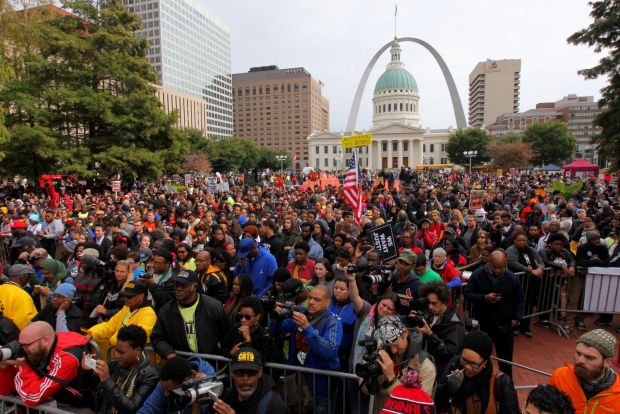
October of 2014, Ferguson October, we gathered in the lawn across from the courthouse, the place infamous for denying Dred Scott his personhood under the law.  We are rallying together to mourn what is lost and to build strength for what is possible.

Kiener Plaza, St Louis, MO

Woop-woop, that's the sound of da police
Woop-woop, that's the sound of da beast
The crowd gets a little more energized.  Some people start rapping along.  I listen along for a while, then I look around me and observe the physical space we are occupying, and recognize this space as a product of the music.
You need a little clarity, check the similarity
The overseer rode around the plantation
The officer is off, patrolling all the nation
The overseer could stop you what you're doing
The officer will pull you over just when he's pursuing
The lyrics are clever, the WHOOP is catchy.  KRS-One is taking his experiences and those of his community, and creating a work of art to share with them.  Then, by replaying this work at the rally, the community is creating physical space for themselves.
The police them have a little gun
So when I'm on the streets, I walk around with a bigger one
The physical boundaries of this community space has been delineated by the audible range of the lyrics.  Anyone within the space who can hear it will be confronted with its charged message - those who identify with it can stay and share their common values with others, and those who find it hostile to themselves can tolerate their awkward outsider status or leave.

KRS One - Sound of Da Police

Chants of protesters and activists have frequently been borrowed from rap, and vice versa.  "No justice, no peace!" we shout.  Then the artists go to their studios and create lyrics that expand their message.

Warrior Minded feat. Dramatik - No Justice, No Peace

Similarly, people on the streets draw from popular songs for their chants, such as when protesters reminded each other “We gon’ be alright.”

Protesters Chanting Lyrics

Kendrick Lamar - Alright

Rap has always been a way to create community space and convey narratives of shared experiences.  I'll leave the details to the experts, but here are a few more examples I highly recommend you experience:

Queen Latifah, Yo-Yo, Lisa 'Left Eye' Lopes (of TLC), MC Lyte, Patra, Nefertiti, Da 5 Footaz, Salt-N-Pepa, Meshell Ndegeocello and others... the song was a tribute to women of the past like Harriet Tubman, Sojourner Truth, Rosa Parks, Coretta Scott King, Shirley Chisholm, and Angela Davis who played major roles in black resistance, as well as the empowerment of women of the present.

BeyoncΓ© - Ghost
Thoughts on capitalism being at odds with creativity.

Miss Bolivia ft. Rebeca Lane & Ali Gua Gua – Libre Atrevida y Loca
Featuring femmes of all sorts of gender expressions and filmed in Argentina, Guatemala, and Mexico (where Miss Bolivia, Lane, and Ali Gua Gua are from, respectively) .

Angel Haze - Same Love (remix of Macklemore & Ryan Lewis)
The only version of this song anyone ever needs to hear.